







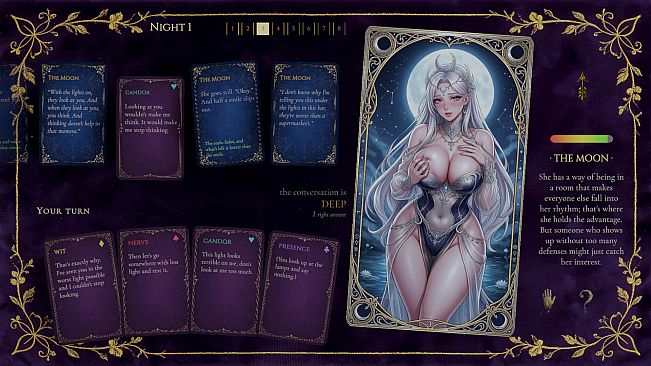










Deck of Desire is a single-player card game in the casual and simulation genres for PC. Players sit at a table where four figures wait among candles and velvet, and each encounter turns into a focused test of observation and deduction. The experience centers on short matches that build tension through repeated attempts to interpret hidden traits, with success leading to further narrative progression beyond the table.
Gameplay
The core loop revolves around facing one of four women drawn from the deck. Each line revealed during a match conceals two qualities chosen from wit, boldness, sincerity, and presence. Correct identification causes her desire to increase over successive turns. An incorrect guess causes her to withdraw. Matches use a compact rule set that can be explained in three sentences and emphasize quick resolution so that one encounter naturally leads into the next.
Four cards define each table setup, and the arrangement ensures that no two matches unfold identically. The simulation aspect emerges from the consistent need to track patterns across turns while the casual pace keeps sessions brief yet repeatable. Visual elements such as the candlelit setting and velvet textures support the intimate atmosphere without adding complexity to the card interactions.
Game Modes
All play occurs in single-player matches against the four available figures. Each figure presents a distinct personality profile that influences how her lines are interpreted, yet the underlying mechanics remain the same across encounters. There are no separate competitive or cooperative modes; the focus stays on sequential one-on-one sessions that reward careful reading of the revealed text.
Progression comes from winning a match, after which the figure appears in a new location rather than remaining at the table. This structure encourages players to cycle through the four figures repeatedly, with each attempt offering fresh combinations of the four qualities.
The Four Figures
The deck contains exactly four women, each defined by the qualities that appear in her lines. Wit, boldness, sincerity, and presence form the complete set of traits players must identify in pairs. Because every line hides two of these qualities, the deduction process requires attention to phrasing and context rather than random selection.
Variety arises from the procedural differences in how lines are presented during each match. The same figure can reveal different combinations across sessions, which keeps the short format engaging even after multiple plays.
Is It Worth Playing?
Deck of Desire suits players who prefer concise, replayable card experiences built around observation and pattern recognition. The rule system keeps barriers low while the four-figure structure provides enough variety to sustain interest across repeated sessions. Those drawn to simulation elements that blend deduction with a light narrative payoff will find the loop satisfying.
Because matches resolve quickly, the game fits well into short play windows without requiring long commitments. The absence of additional modes or ongoing seasonal content means the value rests entirely on the core table mechanics and the consistent challenge of correctly pairing the four qualities. Players who enjoy this focused style of single-player card play are likely to return for additional attempts against each figure.