

Cambell's Oddity Box - Goalf delivers a focused endless arcade mini-golf experience built around precise aiming, power selection, and repeated scoring on procedurally generated holes. The game strips the sport to its core loop of lining up shots, executing them cleanly, and pushing for longer runs without a fixed endpoint. Black-and-white retro pixel art defines the presentation, with chunky visuals, geometric layouts, and old-school arcade effects that emphasize clarity over ornamentation.
Gameplay
Players control shots through straightforward inputs that support mouse, keyboard, or controller. Line up the direction, adjust power for the desired distance or bounce, and release. The system rewards both accuracy on tight angles and controlled low-power putts when the layout demands restraint. Balls interact with walls for bank shots, and each generated hole carries its own par value that factors into the accumulating score. Speed of play also contributes, encouraging efficient routing without unnecessary strokes.
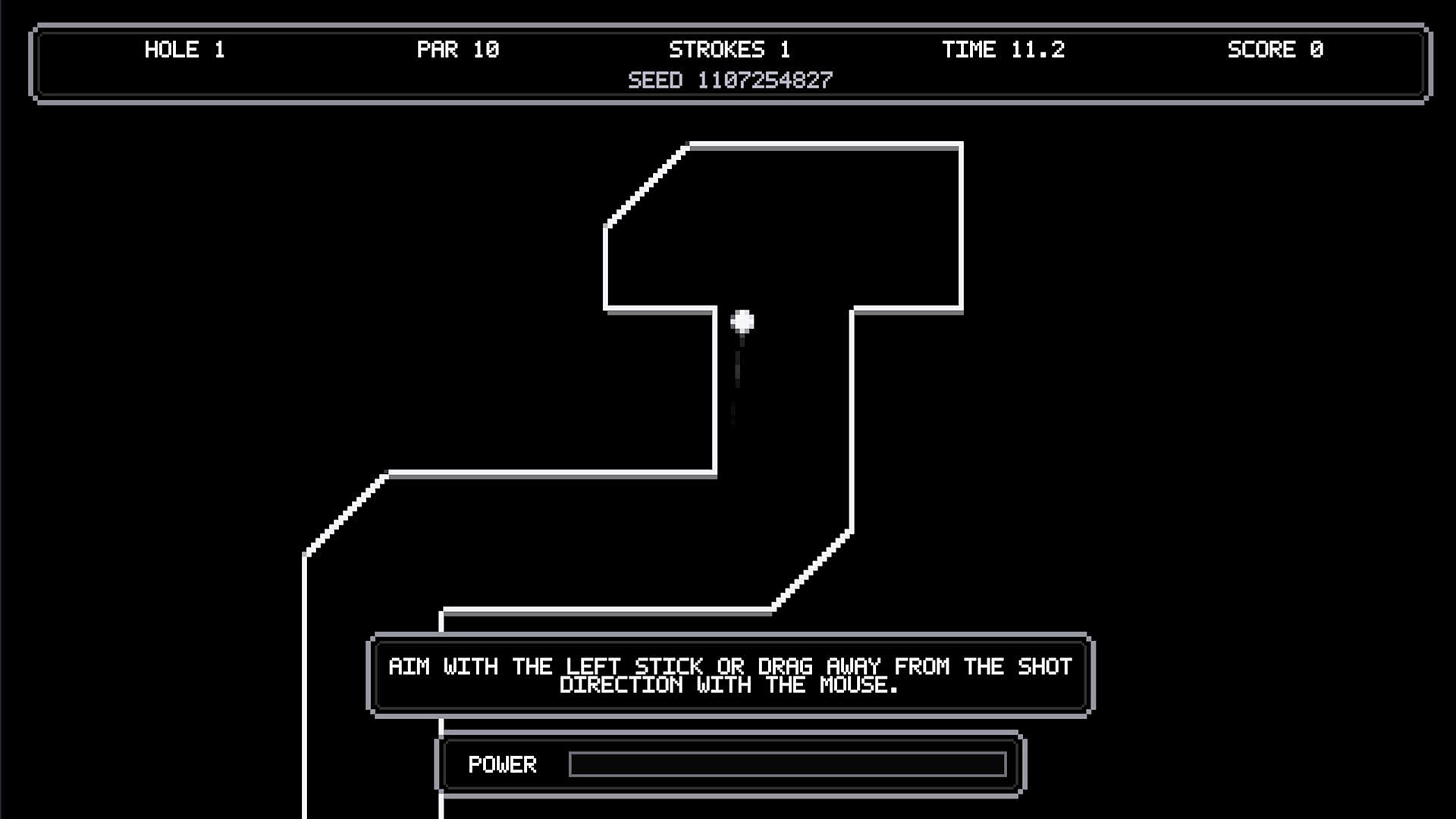
Every hole emerges from a seed that produces readable yet varied courses featuring open spaces, angled surfaces, and multiple viable paths. Completing one hole immediately loads the next, creating an unbroken sequence that continues until the player stops. The generator prioritizes playable designs that still allow for creative recoveries or high-risk attempts. Procedural sound effects accompany impacts and successes, adding responsive audio without complex layering.
Game Modes
The primary experience centers on solo endless runs where the objective remains simple: advance further, improve shot efficiency, and surpass personal bests. A global leaderboard accepts the strongest completed runs for comparison, though lower scores never replace earlier personal records. When online connectivity is active, the game matches players into shared procedural courses that can hold up to ten participants at once.
In these shared sessions, golfers occupy the same hole layout and can observe others moving independently. No turn order exists, balls do not collide or interfere, and each participant advances at their own pace. The system attempts to place newcomers on an existing compatible course when possible, otherwise generating a fresh one that others may later join. Course seeds remain shareable for direct access to specific layouts.
Visuals and Controls
Stark black-and-white pixel graphics keep the focus on geometry and shot trajectories. Trails mark ball movement, impacts produce clear visual feedback, and the camera adjusts dynamically to launches and rebounds. Balls display squash-and-stretch animation on contact, while successful putts trigger a wipe transition to the next hole. The minimalist style extends to the interface, avoiding clutter during active play.
Control options accommodate different preferences. Controller support emphasizes analog precision for subtle adjustments, while mouse and keyboard provide direct aiming alternatives. The design balances full-power drives with delicate short shots, making the same core mechanics suitable across input methods without requiring remapping.
Is It Worth Playing?
Goalf suits players who enjoy score-chasing arcade formats and procedural variety in a compact package. The endless structure removes pressure from completion while still offering clear progression through personal bests and leaderboard placement. Shared courses add a light social layer without introducing direct competition or waiting periods, which appeals to those who prefer independent pacing alongside others.
Precision-focused controls and the black-and-white retro presentation create a distinct identity that rewards careful play over spectacle. The free-to-play model and PC availability lower the barrier for trying the core loop. Those drawn to minimalist design, endless runs, and low-friction multiplayer will find the systems align closely with those preferences, while players seeking narrative depth, fixed campaigns, or traditional competitive rounds may prefer other titles.