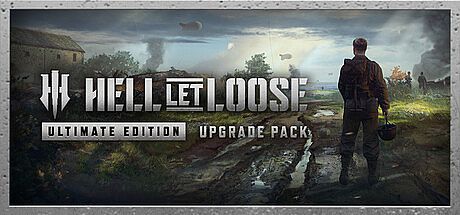





Hell Let Loose is a tactical first-person shooter focused on large-scale World War II combat. Players join 50-versus-50 battles across detailed recreations of historic battlefields on the Eastern and Western Fronts as well as North Africa. The experience emphasizes combined arms warfare, where infantry, armor, and support elements must coordinate to control territory and maintain supply lines.
Gameplay
Matches unfold on expansive maps built from aerial and satellite imagery of real locations. These battlefields divide into sectors that form shifting front lines. Players select from 14 specialized roles across command, infantry, recon, and armor categories. Each role carries historically accurate weapons, equipment, and vehicles, with realistic ballistics and recoil that reward precise handling.
Teamwork drives every engagement. Squads operate under officers who communicate with a commander through dedicated voice channels, while proximity chat handles local coordination. Resource management plays a central role as teams gather supplies to call in reinforcements, artillery strikes, bombing runs, and new vehicles. Engineers construct defenses and nodes that sustain the front line, while medics, anti-tank crews, and machine gunners fill critical battlefield functions. Persistent progression lets individuals level separate roles to unlock uniforms and loadouts.
Vehicles such as the Tiger, Sherman, Stuart, and Puma dominate open ground when crews work together. Heavy weapons like anti-tank guns and artillery provide additional firepower once positioned correctly. The result is a slow-burn pace where positioning, communication, and supply control often outweigh raw individual skill.
Game Modes
Two primary modes structure the matches. Warfare pits two teams against each other in a tug-of-war over five sectors. Both sides begin with partial control of the map and fight to capture or hold the majority of sectors before a 90-minute timer expires, or to push all the way to the enemy headquarters.
Offensive assigns clear attacker and defender roles. The attacking team must capture successive sectors within 30-minute windows per objective, while defenders hold the line to prevent any advance. Once a sector falls it cannot be retaken, forcing defenders to fall back methodically. These modes create distinct rhythms: Warfare allows fluid back-and-forth pushes, while Offensive delivers focused, high-stakes assaults.
Additional variety comes from Skirmish, which condenses action around a single central objective on a smaller map section. Across all modes, 99 capture-point variations per map ensure no two battles play out identically.
Maps and Progression
Iconic locations include Omaha Beach, Carentan, Stalingrad, Kursk, and Foy. Each map recreates war-torn terrain with forests, towns, bridges, and open fields that favor different tactics. Frequent updates add new maps, weapons, and features while refining existing systems.
Role-specific leveling encourages players to master multiple classes rather than sticking to one. Unlocks focus on cosmetic and loadout options that reflect historical accuracy without altering core balance.
Is It Worth Playing?
Hell Let Loose delivers its most satisfying results to players who value communication and coordinated strategy over fast-paced arcade action. Matches reward squads that maintain supply lines, call accurate fire support, and adapt to shifting front lines. The game maintains an active player base with regular content updates that keep maps and mechanics fresh.
Reception remains very positive across hundreds of thousands of reviews, with praise centered on the scale of the battles and the depth of the command structure. Those seeking realistic World War II combat with meaningful teamwork will find repeated value in the persistent role progression and emergent gameplay. Players who prefer solo or low-communication experiences may find the emphasis on voice coordination and large-scale tactics less appealing.