







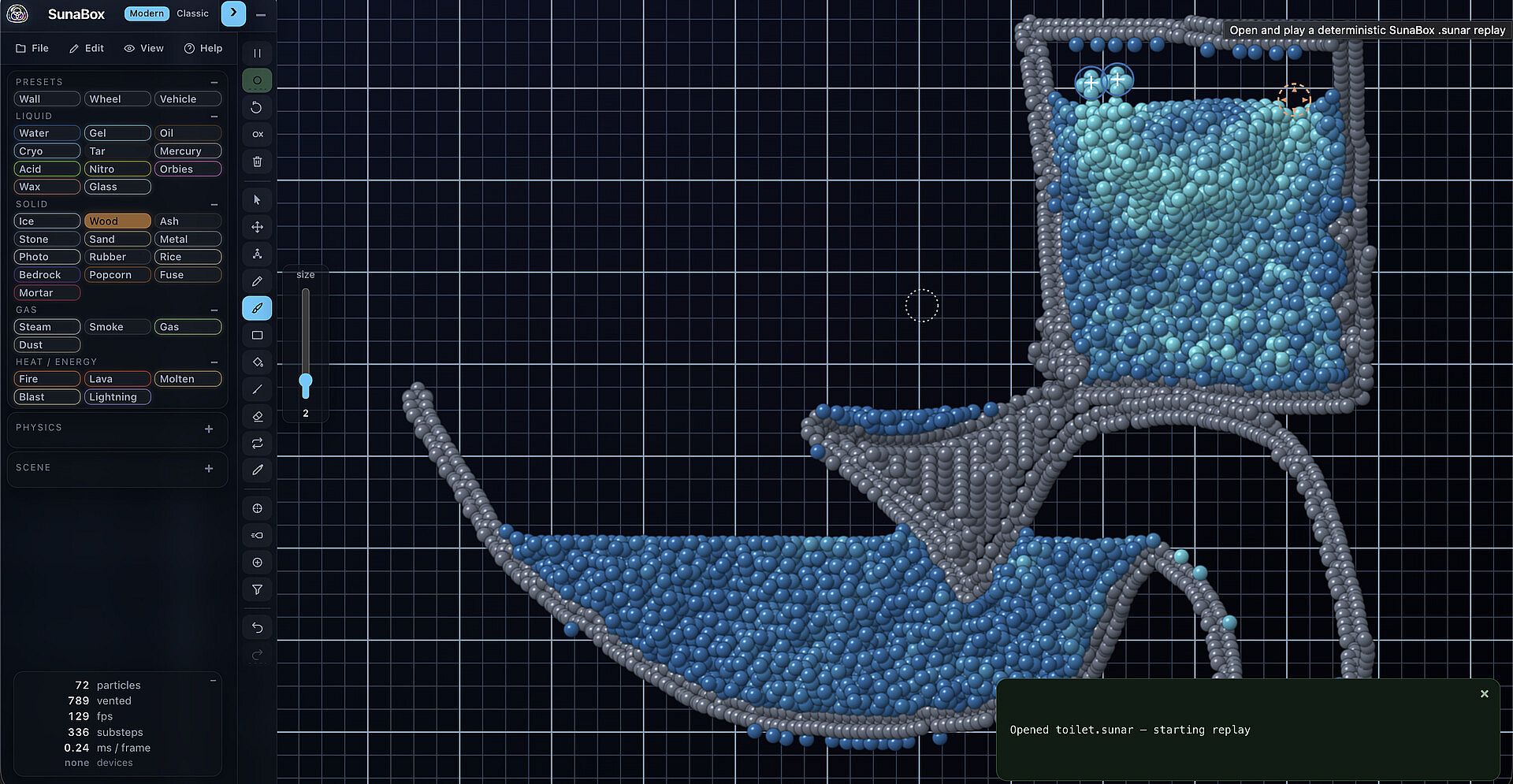
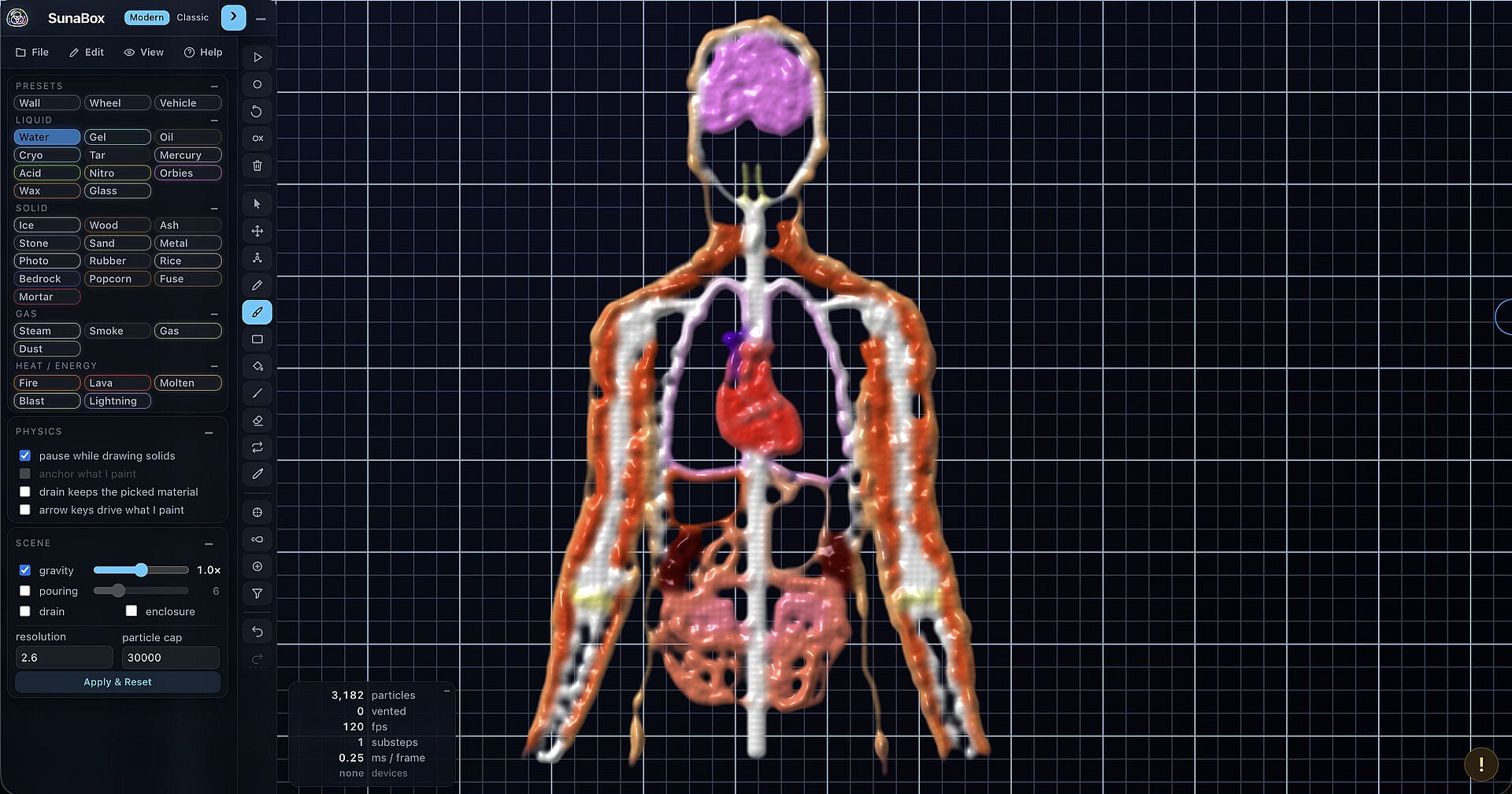
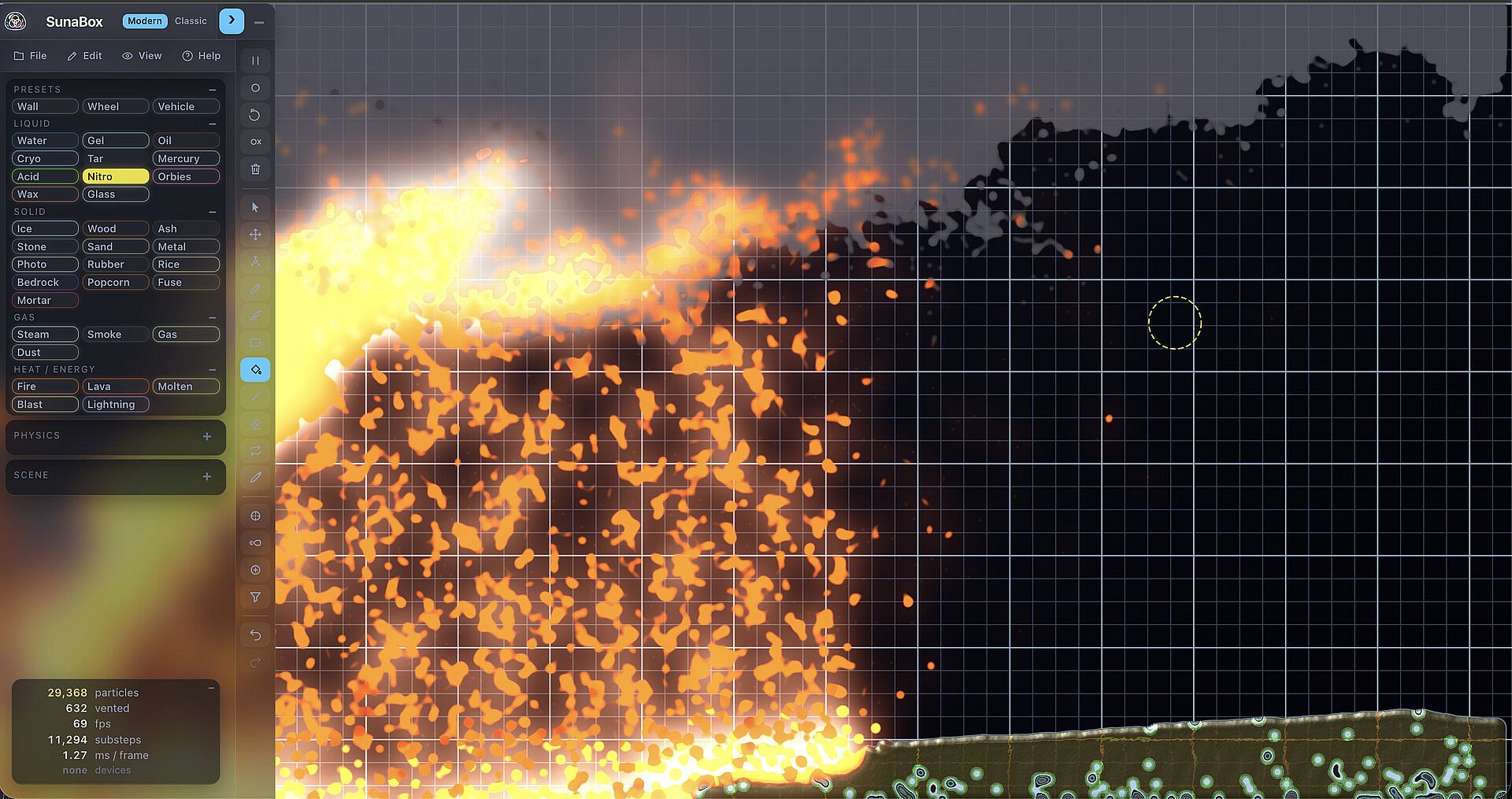
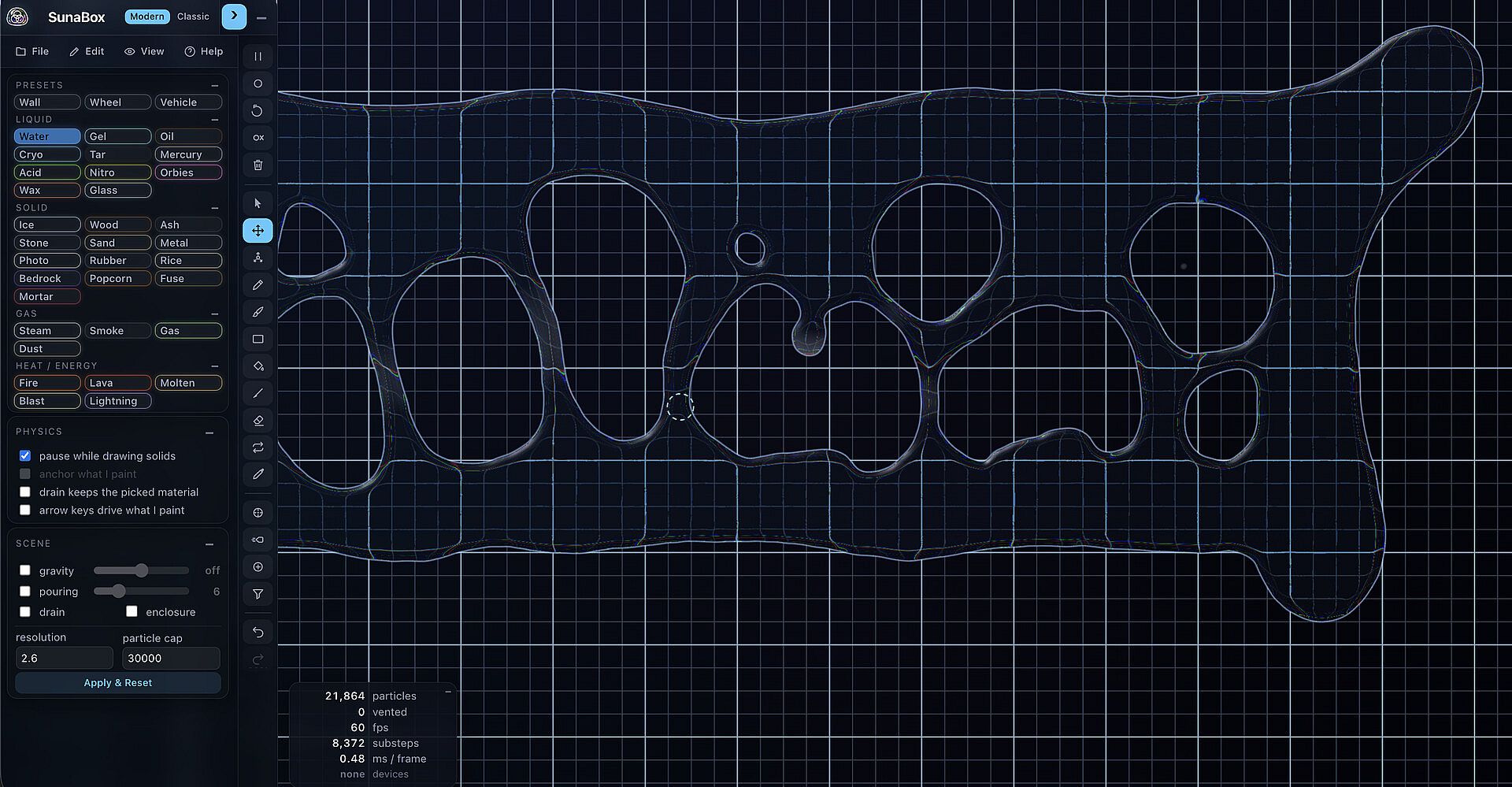
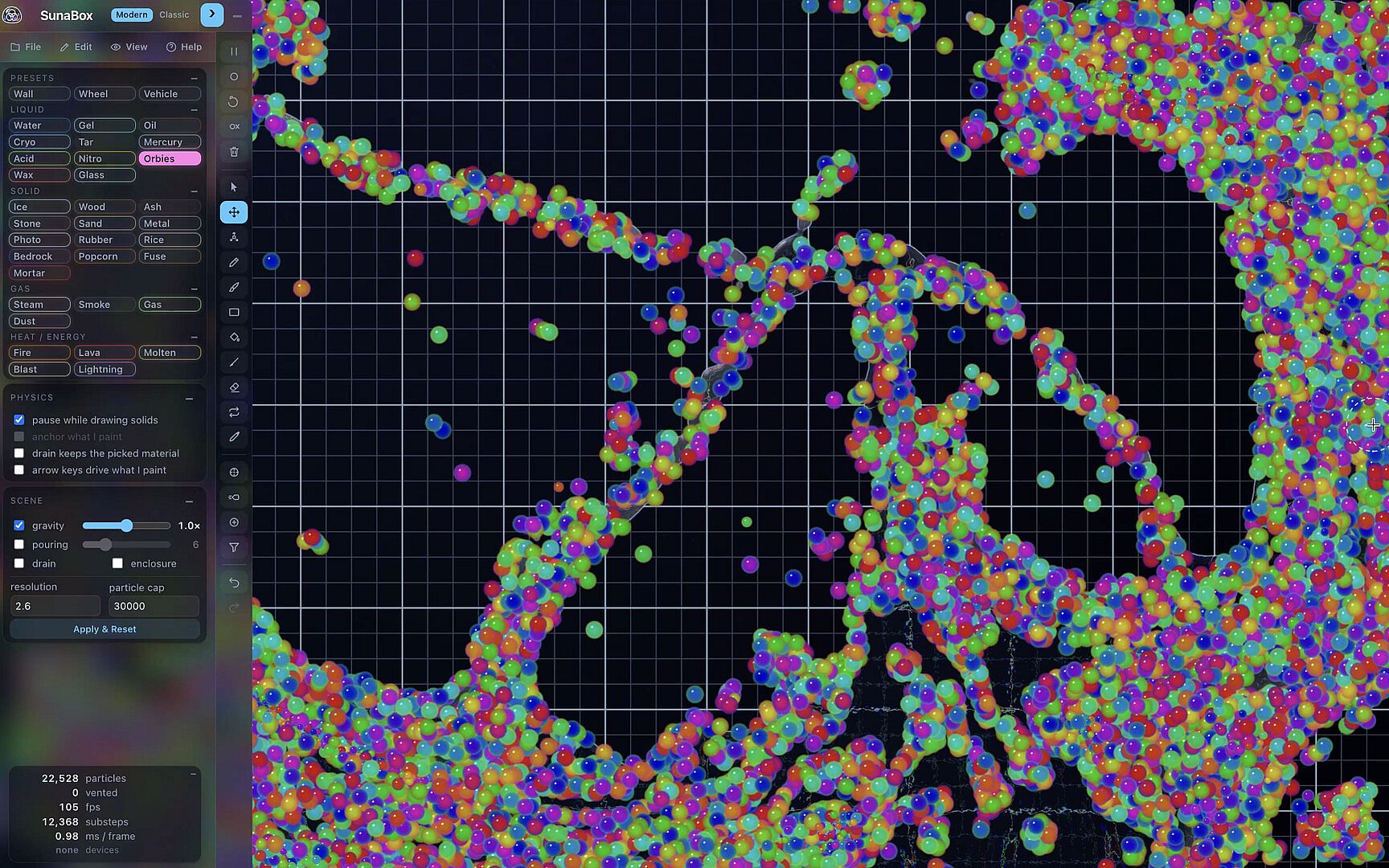
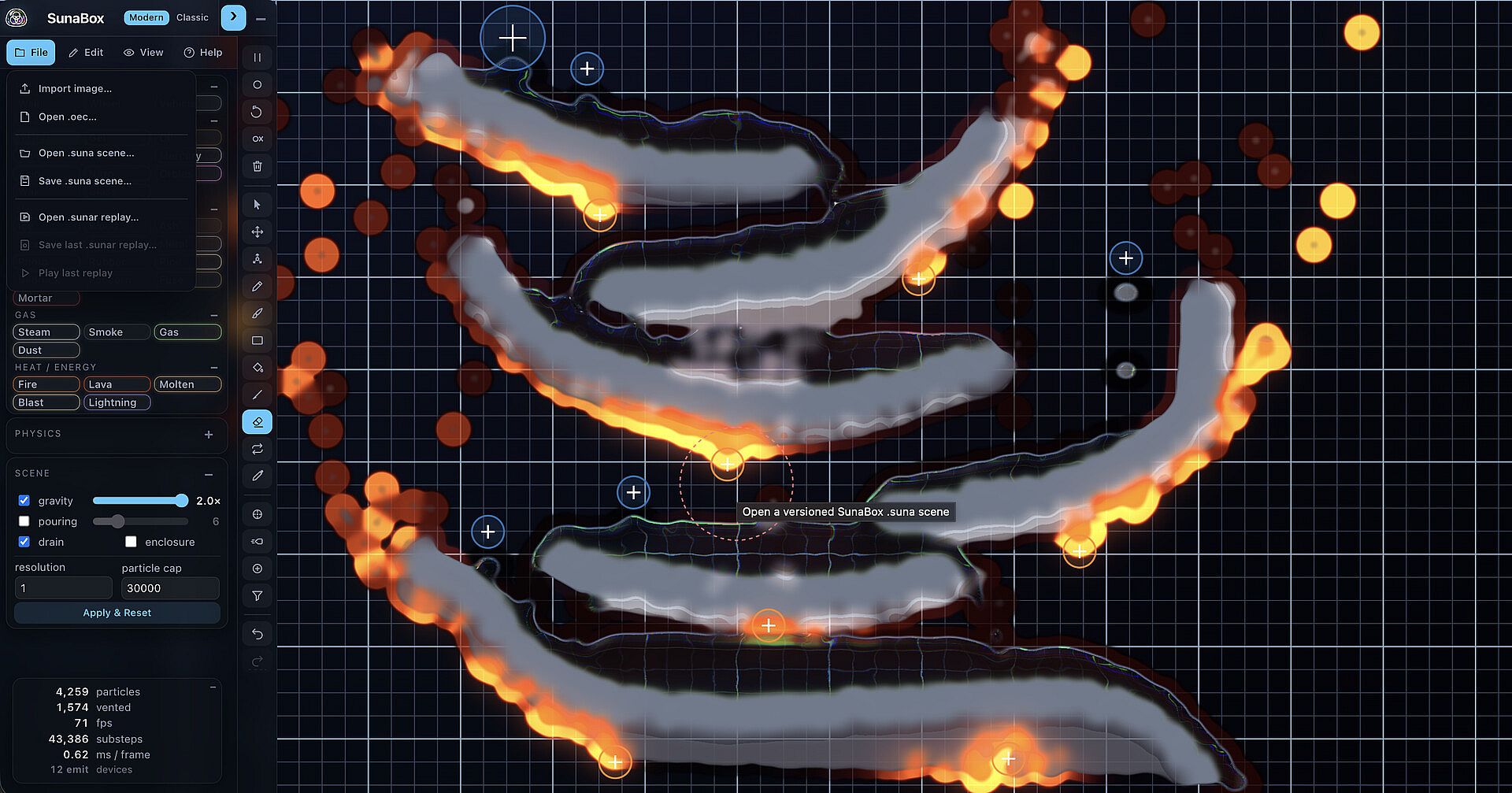

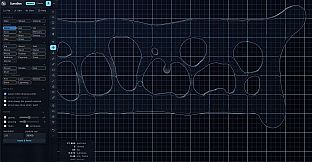
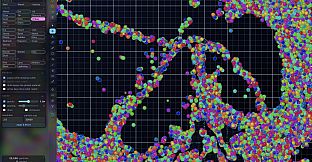
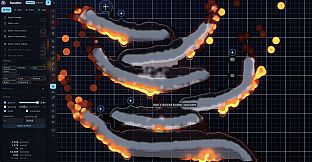
SunaBox is a particle physics simulation game that revives the spirit of the 2007 classic OE-CAKE in a modern, deterministic engine. This indie casual simulation title for PC lets players paint and interact with dozens of materials that follow realistic rules for thermodynamics, fluid dynamics, and rigid body mechanics. Built as a clean-room successor, it supports faithful loading of legacy .oec files while adding features like PNG imports and precise time manipulation that were impossible in the original.
Gameplay
Core gameplay revolves around painting matter directly into a 2D world where each of the 27 materials behaves according to its physical properties. Water flows and mixes with gel or oil, ice melts under heat, wood burns into ash, steam condenses back into liquid, and nitro reacts explosively when triggered. Players use tools to weld strokes into rigid structures, attach pins for axles, apply jets for propulsion, or stretch rubber elements into functional slingshots and springs.
Arrow keys allow direct control of painted objects, turning static scenes into drivable machines. Any PNG image can be dropped in and assigned material properties, converting drawings, logos, or photos into rigid, liquid, or flammable elements within the simulation. The engine runs deterministically and bit-exact, recording every session as an initial state plus player inputs. This system enables smooth rewinding, full replays from any point, and sharing of compact files that reproduce identical results on other machines.
Thermodynamics add depth as fire spreads realistically, lava cools into stone, and drains or collectors manage particle flow. Lightning effects and swelling orbies further expand creative options for building interactive contraptions.
Game Modes
SunaBox operates primarily as an open-ended physics sandbox where players freely experiment, build, and iterate without structured objectives. A dedicated classic mode toggle instantly switches the interface to match the original OE-CAKE layout, preserving exact toolbar positions, button order, and muscle memory from the 2007 version.
This single toggle transforms the experience for returning players while the underlying engine delivers higher particle limits, improved resolution, and native performance on Windows, macOS, Linux, and Steam Deck. No additional competitive or narrative modes exist; the focus remains on creative simulation and precise reproduction of scenes.
Key Features and Mechanics
The simulation emphasizes real-world physics interactions across all materials. Rigid bodies connect via welds and pins, jets provide thrust, and rubber behaves elastically under tension. PNG imports integrate seamlessly, allowing custom content to participate fully in the physics rules.
Deterministic recording stands out as a core mechanic. Sessions export as lightweight files that guarantee identical playback anywhere, supporting easy sharing and verification. The open-source SunaEngine powers everything, with options for higher particle counts and finer world resolution in the full release compared to the free browser demo.
Compatibility with old .oec scenes ensures continuity for longtime fans, loading them exactly as created while unlocking new tools and scale.
Is It Worth Playing?
SunaBox targets players who enjoy creative physics toys, simulation experiments, and building functional machines from simple elements. Its deterministic engine and replay tools appeal especially to those interested in sharing reproducible scenes or revisiting past creations with perfect accuracy. The classic mode provides immediate familiarity for OE-CAKE veterans, while PNG support and expanded materials broaden possibilities for new users.
Availability on multiple desktop platforms plus Steam Deck support makes it accessible for relaxed sessions at any pace. With a free browser demo offering the full feature set at reduced scale, interested players can test the core loop before the November 2026 Steam release. Those drawn to particle-based building, realistic material interactions, and time-reversible simulations will find substantial depth in its systems.












