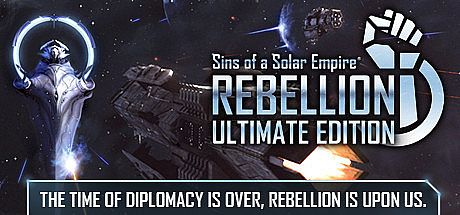








Sins of a Solar Empire Ultimate Edition combines the original real-time strategy title with its Rebellion expansion and several content packs into one package for PC. The game places players in command of spacefaring civilizations locked in a prolonged conflict across star systems filled with planets, asteroids, and phase lanes that connect distant sectors.
Gameplay
Core play revolves around the classic 4X loop executed in real time. Players begin on a homeworld and must colonize additional planets to grow population and extract resources such as credits, metal, and crystal. These materials fund ship construction, orbital structures, and technology research. Fleets travel through phase lanes, allowing rapid movement between connected systems while exposing them to ambushes at choke points.
Each of the three main factions offers distinct approaches. The TEC emphasizes industrial output and ballistic weaponry, favoring durable ships and economic networks. The Advent relies on psychic abilities and cultural spread to influence planets without direct combat. The Vasari use advanced phase technology for hit-and-run tactics and rapid relocation. Rebellion splits each faction into loyalist and rebel variants that alter research paths, unit availability, and strategic priorities such as defense focus or aggressive expansion.
Capital ships serve as mobile command centers that level up through combat and unlock powerful abilities. Larger vessels like titans appear later and can shift the balance of major engagements. Defensive starbases guard key planets and can be upgraded with specialized weapons and support modules. Resource management extends beyond simple extraction to include trade routes and population growth that directly affect income.
Game Modes
Matches take place on procedurally generated or preset maps that range from compact single-star systems to sprawling multi-star galaxies. Victory conditions include military conquest, research dominance, diplomatic alliances, or control of specific objectives such as the last capital ship or planetary occupation.
Single-player options center on skirmishes against AI opponents of varying difficulty, with adjustable starting conditions and map parameters. Multiplayer supports up to ten participants through online or LAN connections, allowing free-for-all battles, fixed teams, or dynamic alliances that shift during play. Co-operative modes let players team up against shared AI threats.
Additional map types introduced through content packs alter resource distribution, add neutral factions, or impose restrictions that encourage different fleet compositions and territorial control strategies. Scenario maps provide fixed setups with specific win objectives that test particular mechanics without full sandbox freedom.
Factions and Strategic Depth
TEC loyalists leverage economic strength for sustained production and defensive starbase networks, while rebels prioritize raiding and rapid fleet deployment. Advent variants differ in how they apply unity mechanics for planetary conversion or direct combat support. Vasari subfactions balance phase mobility with varying degrees of long-term infrastructure investment.
Research trees branch into military, civic, and faction-specific categories. Upgrades improve ship armor, weapon range, resource efficiency, and special abilities. Minor factions scattered across maps can be courted for bonuses or eliminated for territory. The interplay between expansion speed, fleet composition, and defensive positioning creates layered decision-making that rewards planning across multiple fronts.
Is It Worth Playing?
The Ultimate Edition delivers the complete original experience plus Rebellion content and map expansions in a single purchase. It suits players who enjoy large-scale real-time strategy with persistent empire management and fleet command rather than fast-paced action. Matches can last hours as empires grow and clash across dozens of systems.
Support for both solo skirmishes and multiplayer sessions provides flexibility for different group sizes. The absence of a linear campaign means all play occurs through customizable scenarios or open matches, which appeals to those who prefer replayability through map variety and faction choices. Those seeking complex systems with meaningful trade-offs between economy, technology, and military power will find substantial depth here.