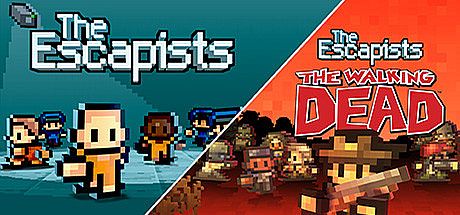




The Escapists + The Escapists: The Walking Dead Deluxe bundles two related strategy simulation games built around top-down pixel art prison escape mechanics. The core title places players in the role of an inmate navigating strict daily schedules while secretly preparing an exit. Its companion entry shifts the setting to the Walking Dead universe, where the same foundational systems support survival against walkers instead of guards.
Gameplay
Players must balance visible compliance with hidden preparation. Each day follows a fixed routine that includes mandatory roll calls, meals, assigned work shifts, exercise periods, and showers. Missing non-mandatory activities raises suspicion, while skipping roll calls triggers lockdowns. Free time is spent searching cells and common areas for materials, completing favors for other inmates to earn currency, and trading for useful items.
Items combine in a crafting grid to produce tools such as shovels for tunneling, wire cutters, plastic keys, and guard disguises. Strength, speed, and intelligence stats improve through repeated exercise, library use, or computer work, unlocking better crafting options and combat effectiveness. Combat occurs when necessary but draws attention and risks solitary confinement or item confiscation. Escape routes vary by facility layout and can involve digging under walls, cutting fences, impersonating staff, or creating distractions.
The Walking Dead edition retains the routine and crafting loop but replaces guard patrols with walker threats. Players control Rick Grimes and lead a small group of survivors. Scavenging runs outside the base yield supplies while managing morale through shared tasks. Combat emphasizes melee weapons crafted from household objects, with limited firearms that attract more walkers when fired. Daily head counts and maintenance chores keep the group functional and reduce external pressure.
Game Modes
The primary experience consists of sequential prisons or scenarios that increase in complexity. Each location features unique layouts, guard or walker patterns, and required escape preparations. Progress unlocks the next facility after a successful breakout.
An additional creation tool in the original game lets players design custom prisons using available assets and share them for others to attempt. The Walking Dead entry structures its content as five distinct scenarios drawn from comic events, each with set objectives tied to survival and relocation rather than repeated prison breaks.
Core Systems and Progression
Resource management drives long-term planning. Currency from jobs or favors funds purchases from inmate networks, while hoarded junk becomes improvised equipment. Heat levels track detected infractions and influence guard responses. In the Walking Dead variant, survivor condition and base integrity replace heat as the primary risk meter, with failed scavenging or neglected routines increasing walker incursions.
Both entries reward experimentation. Multiple viable paths exist to complete any given facility or scenario, and failed attempts simply return the player to the start of that location with lost items. This structure encourages repeated playthroughs to refine timing, stat builds, and item combinations.
Is It Worth Playing?
These games suit players who prefer deliberate planning, inventory management, and trial-and-error problem solving over fast-paced action. The bundle delivers the original prison-break sandbox alongside a themed survival take that adapts the same loop to zombie threats and group leadership. Both remain single-player experiences focused on methodical progression through a handful of contained maps.
Long-term support has ended, yet the titles continue to function on modern PCs without additional requirements. Those drawn to crafting systems, stealth timing, and open-ended escape solutions will find consistent depth across the pair. Players seeking constant updates or multiplayer features should look elsewhere, as the content is self-contained and unchanged since release.