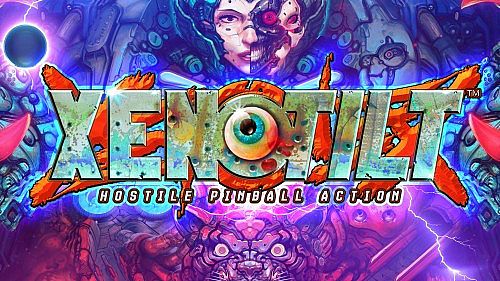


Xenotilt: Hostile Pinball Action is a pinball action game available on Nintendo Switch. It serves as the sequel to the earlier title Demon's Tilt and places players on a single expansive three-tier table aboard the derelict spaceship Samaritan, which has been overrun by the Xenophage swarm.
Gameplay
The core loop centers on launching a ball onto the three-story playfield and keeping it in motion while scoring points through targets, bumpers, and direct confrontations with bosses. Each tier features a central boss entity that players damage by striking it with the ball or by using the turret system. Cradling the ball on a flipper allows access to auto-turrets that fire large projectiles to clear enemy swarms and incoming volleys.
Nudging the ball itself with the left stick helps direct shots or avoid drains, though excessive nudges within a short window trigger a tilt warning and potential game over. The multiball matrix holds up to nine balls and serves as the hub for the perk system, where filling slots grants one of nine distinct upgrades that affect weapons, defense, or scoring multipliers. These perks activate during multiball phases and create opportunities for chain reactions and higher scores. The table includes moving elements, animated hazards, and a constant stream of bullet-hell patterns from enemies and bosses.
Progression involves managing limited balls while pursuing high multipliers and completing objectives tied to each boss. The design rewards precise flipper control and timely use of turrets and perks rather than relying solely on traditional pinball ramps or loops.
Game Modes
Four distinct modes alter the rules and objectives while sharing the same underlying table. Normal Mode follows standard pinball conventions with balanced difficulty and three balls, serving as the entry point for learning the physics and layout.
EX Mode expands the experience with additional rules and access to separate bonus sub-tables. Players locate and rescue survivors on these mini-areas, each with unique mechanics such as specialized targets or hazards. Rescued survivors provide permanent skill upgrades, and successful core overkills on bosses award further power boosts.
Hardcore Mode restricts players to a single ball with smaller flippers and heightened challenge, demanding tighter control and strategic tilt use to maximize a run. Crisis Mode functions as a time-attack variant where survival depends on collecting time extensions and targets amid ongoing threats, with a multiball element that changes priorities toward longevity rather than pure scoring.
Table and Presentation
The Samaritan table spans three vertical tiers connected by flippers and pathways, each layer themed around sections of the infested vessel. Boss encounters include entities such as Hera, a rogue AI pirate queen, Chrysalis as a swarm protector, Tiger Supreme as onboard security, and others like Star Pilot, Mecha-Neko, Olmech, and Brood Mother. These encounters drive the action with distinct attack patterns and point opportunities.
Visuals draw from 16-bit era spritework with vibrant colors, realtime lighting effects, and dense particle displays during intense sequences. The soundtrack features original tracks composed by EC2151 in a style reminiscent of classic console audio. TATE mode support rotates the display for a vertical orientation suited to the tall table layout.
Is It Worth Playing?
Xenotilt: Hostile Pinball Action delivers a focused single-player experience built around repeated attempts to improve scores and master the table's systems. Reviews from multiple outlets highlight its addictive quality and depth, with many players returning for additional runs due to the combination of precise mechanics and escalating chaos. The game runs on Nintendo Switch in handheld, tabletop, and TV modes, and it has received consistent praise for its audiovisual presentation and mode variety.
Those who enjoy pinball titles with added action layers or who appreciate challenging single-player arcade-style games will find substantial replay value here. The four modes provide different entry points and difficulty curves without requiring external progression systems. Reception remains strongly positive across platforms, with the Switch version noted for its faithful adaptation of the core experience.