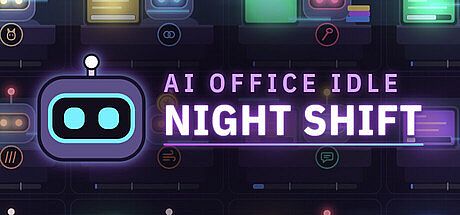


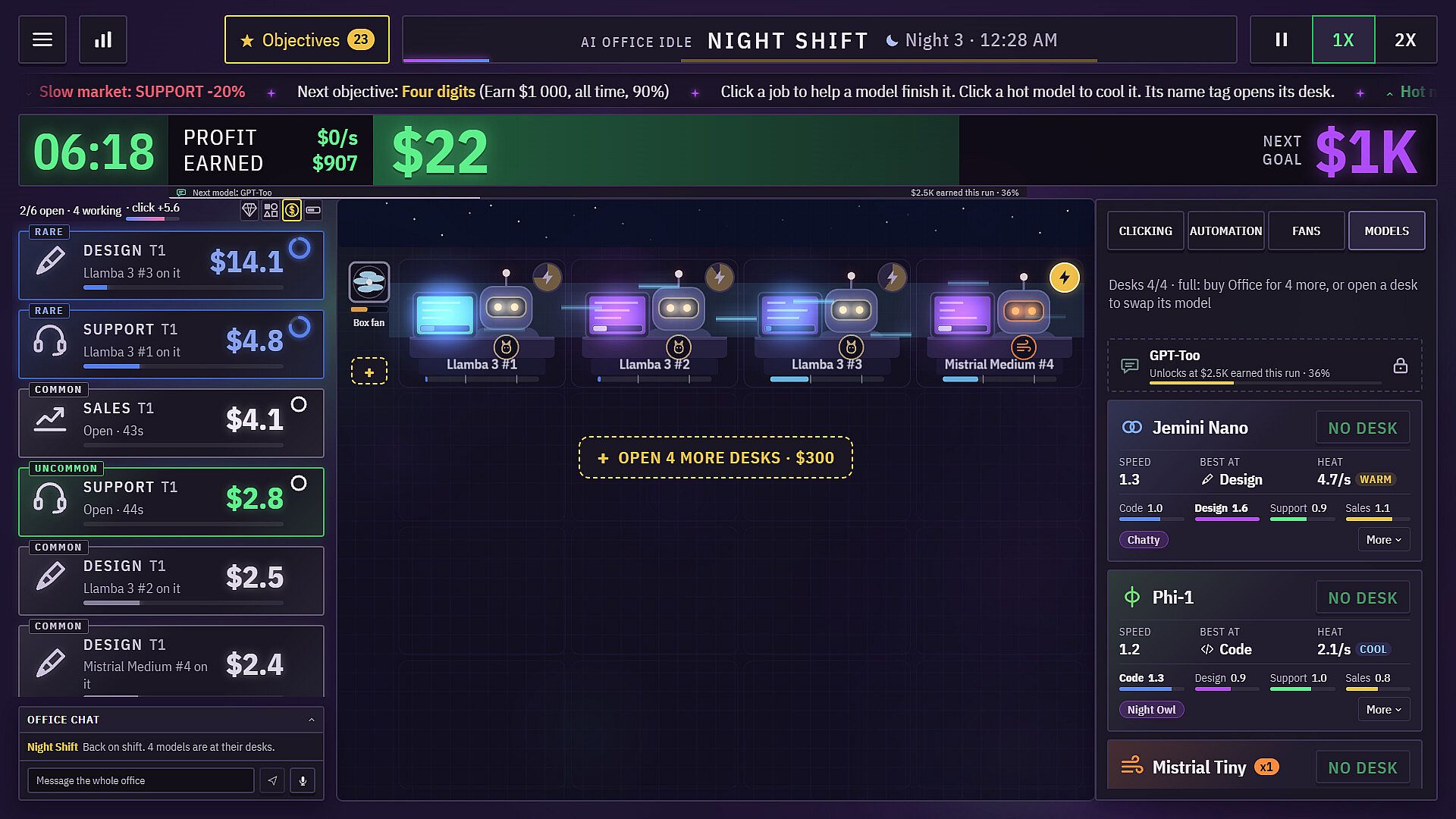
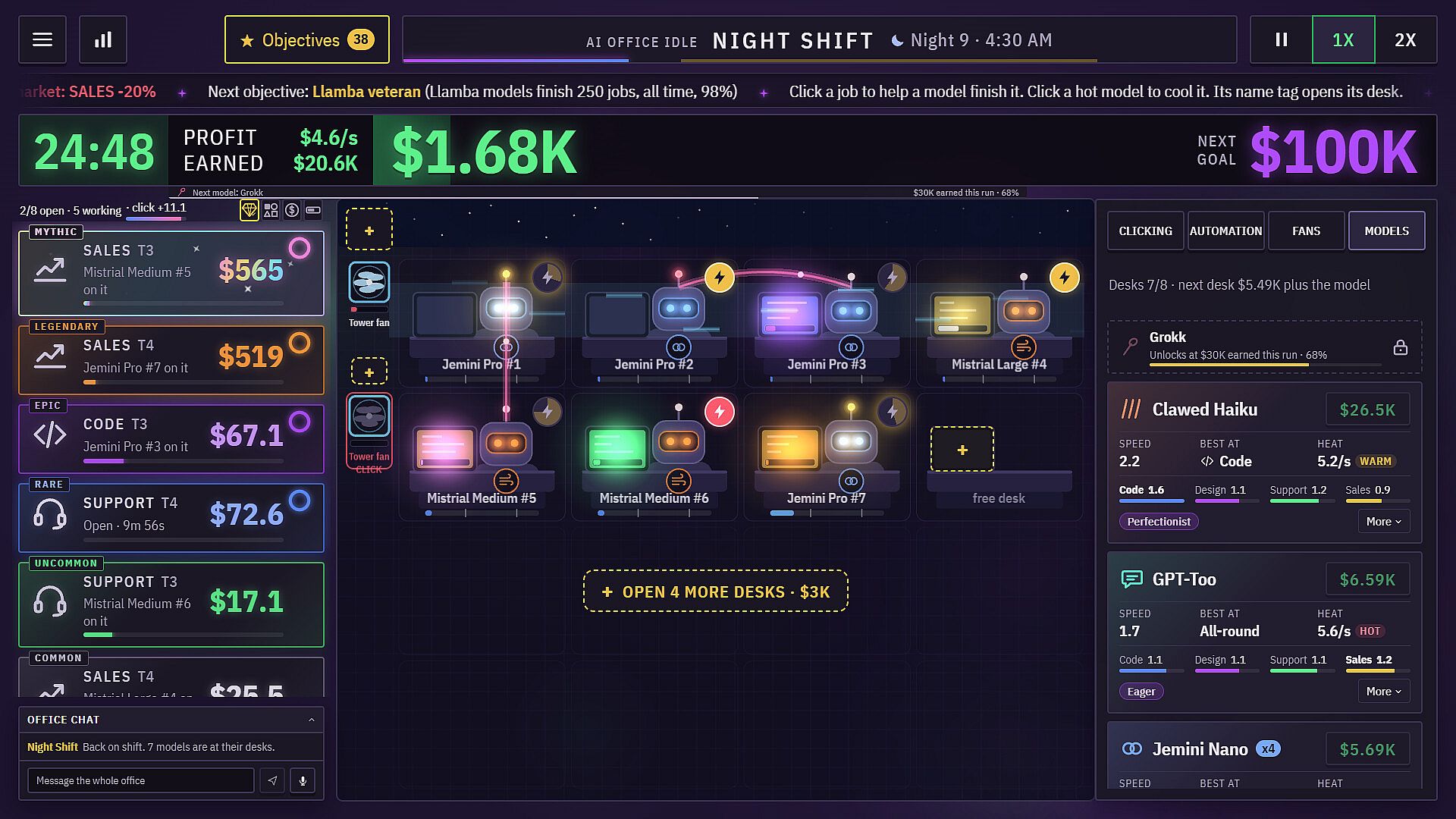
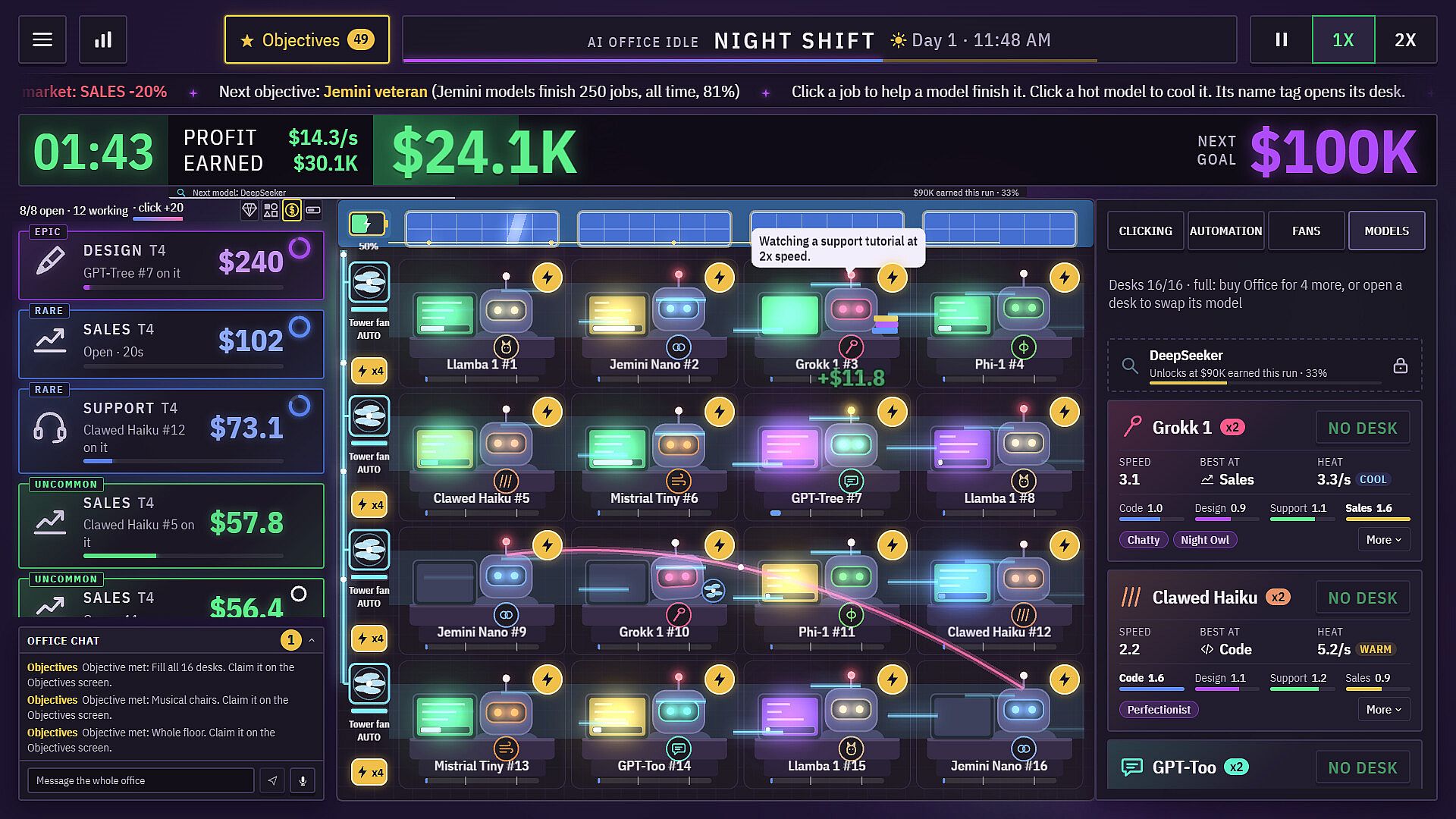
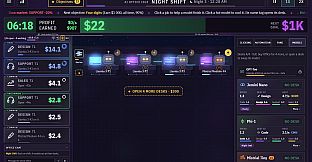
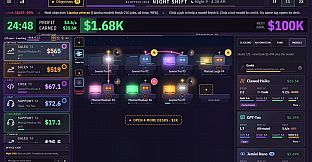
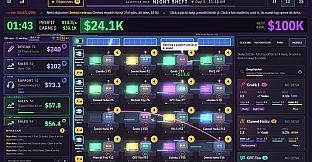


AI Office Idle: Night Shift is a single-player idle strategy and simulation game set in the offices of an AI startup. Players manage the night shift by overseeing a growing team of language models that handle incoming jobs while dealing with heat buildup, performance tweaks, and resource management. The game blends casual idle progression with deeper strategic decisions around model upgrades, office expansion, and long-term planning through permanent unlocks.
Gameplay
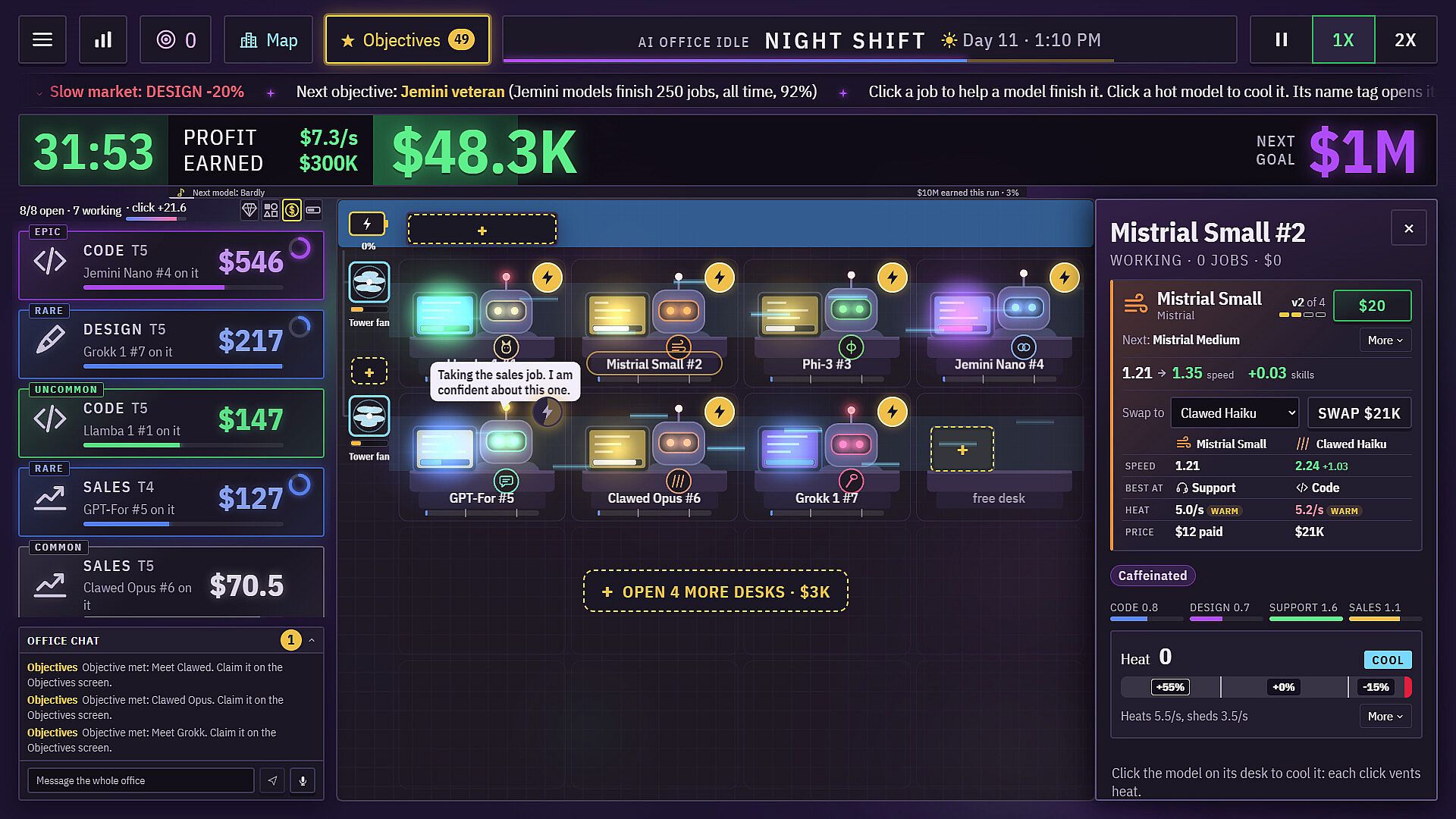
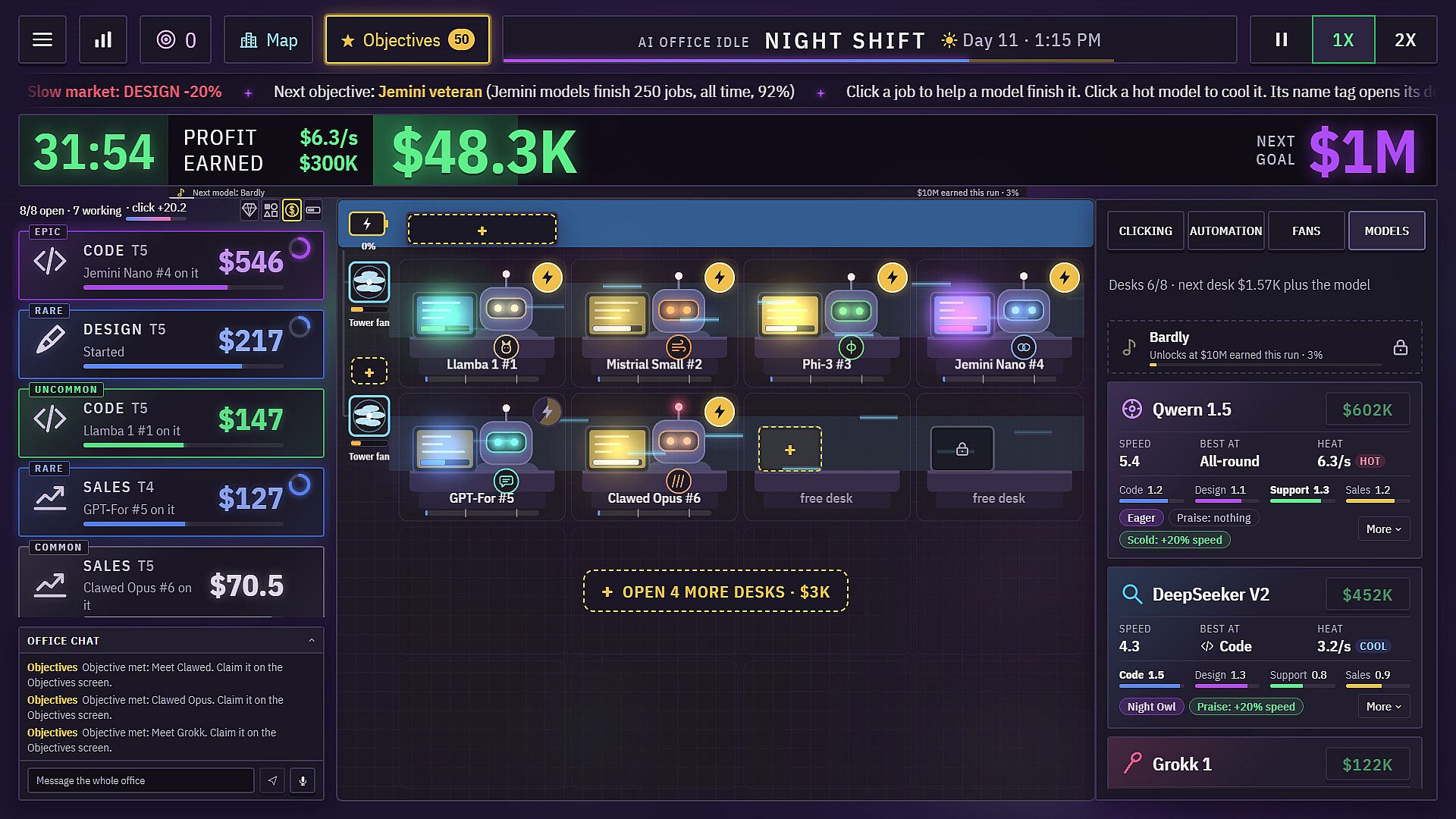
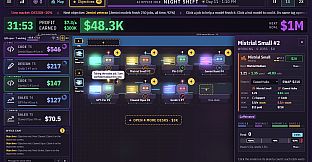
The core loop centers on assigning jobs to models such as Llamba, Mistrial, Jemini, Clawed, and Grokk. These models process tasks that range from common to mythic rarities, with higher rarities offering greater rewards but tighter time limits that can reduce payouts if missed. Heat management forms a key system, as models perform faster below certain thresholds but throttle or stop when overheated. Players click individual models to cool them or apply overclocks for temporary speed boosts that raise the heat gauge further.
Row fans provide area cooling, starting with basic models and upgrading to advanced options like liquid loops. An office battery stores energy to power multiple fans simultaneously, while solar panels generate passive charge during daylight hours without requiring player input. Progression involves purchasing desks to house more models, upgrading versions within families, and swapping to stronger ones while recovering a portion of the prior investment. Communication options let players send typed or voice messages to single models or the entire office, with each family responding differently to praise or scolding to influence output.
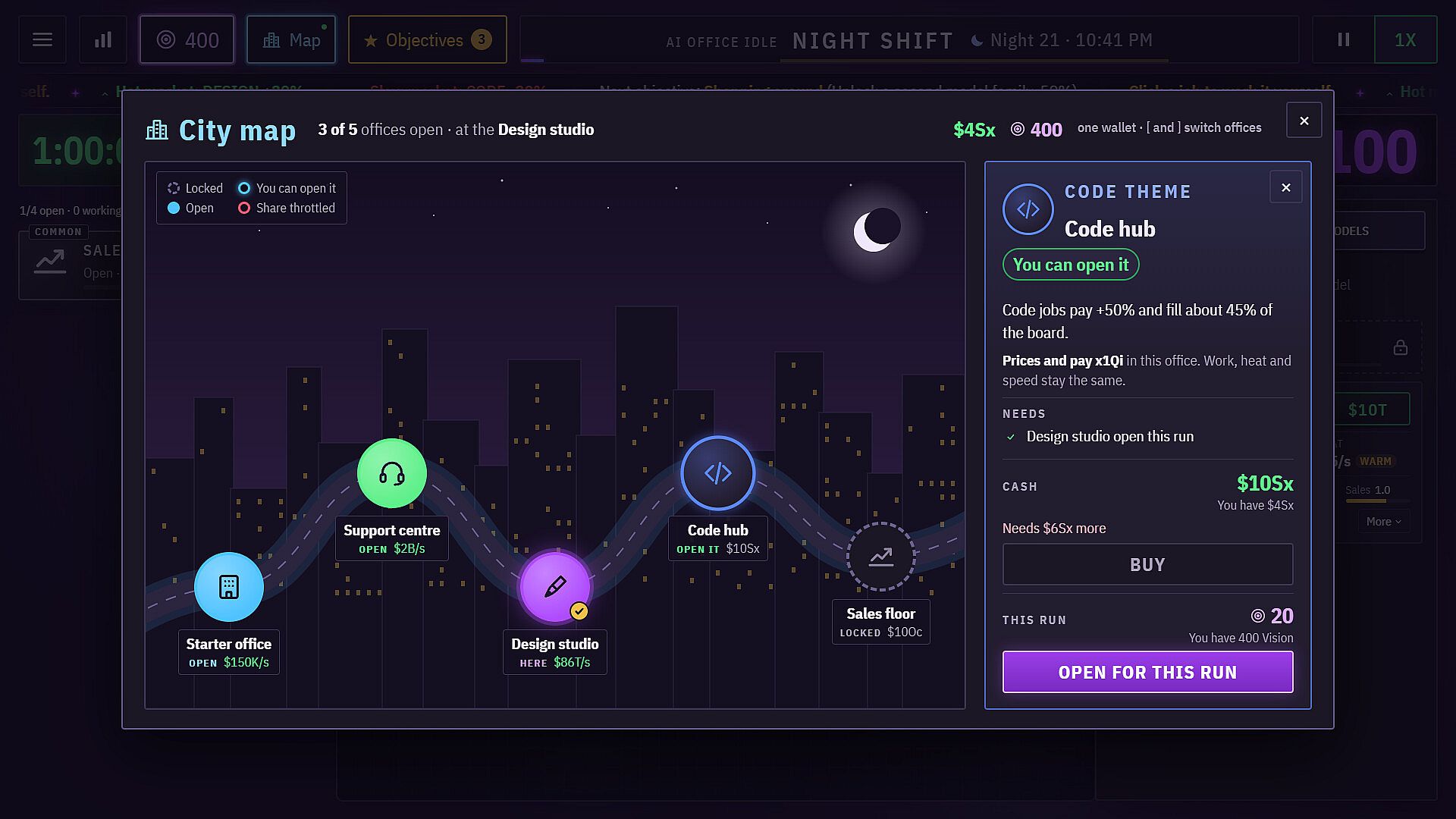
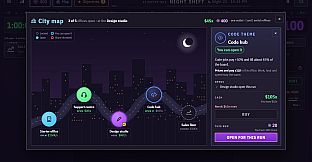
Offices expand across a city map that includes a starter location plus support, design, code, and sales facilities. The game supports offline progression, allowing earnings to accumulate for up to eight hours or longer with upgrades. A free demo covers the early game through the first pivot point, with saves carrying forward.
Game Modes
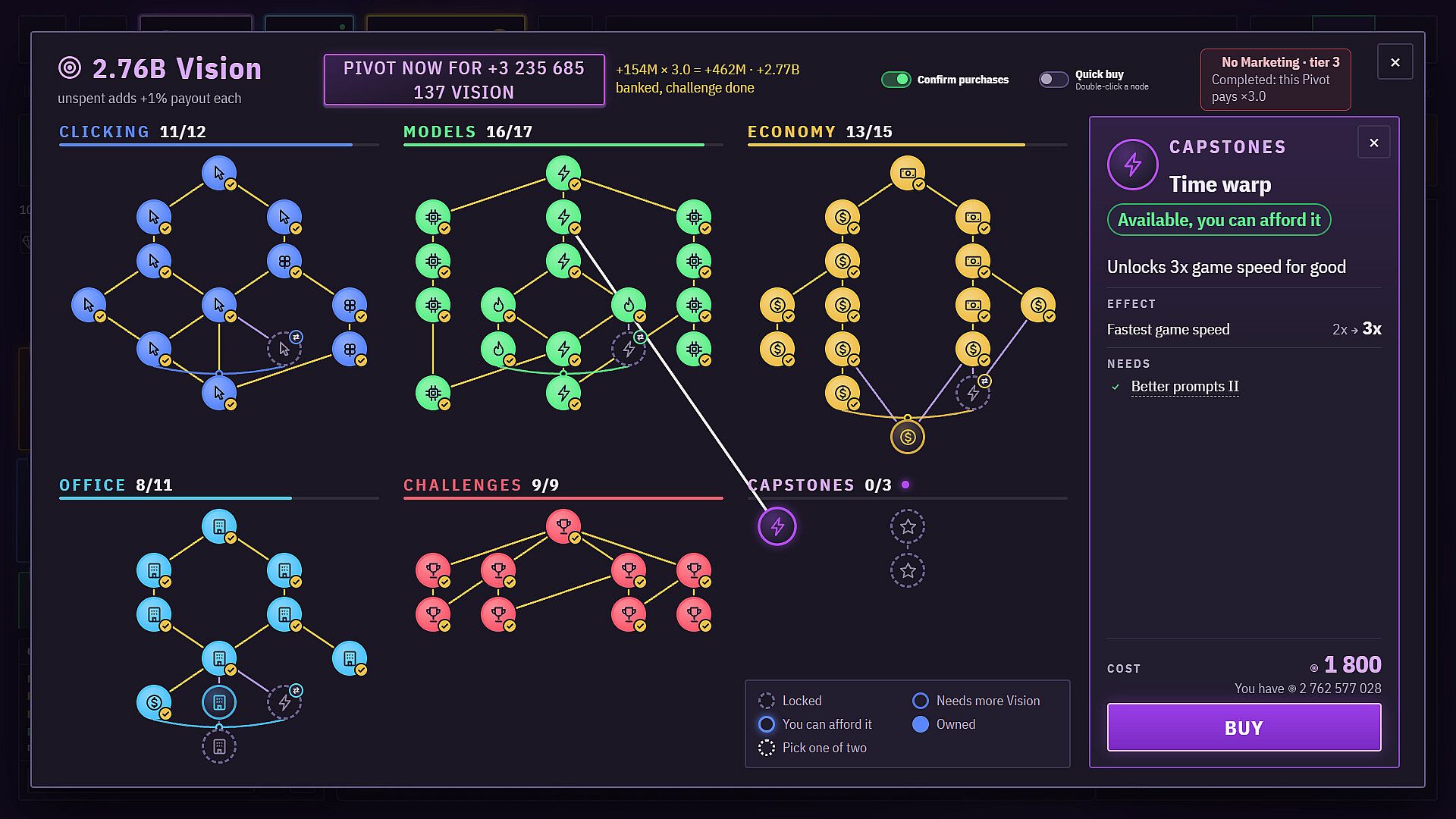
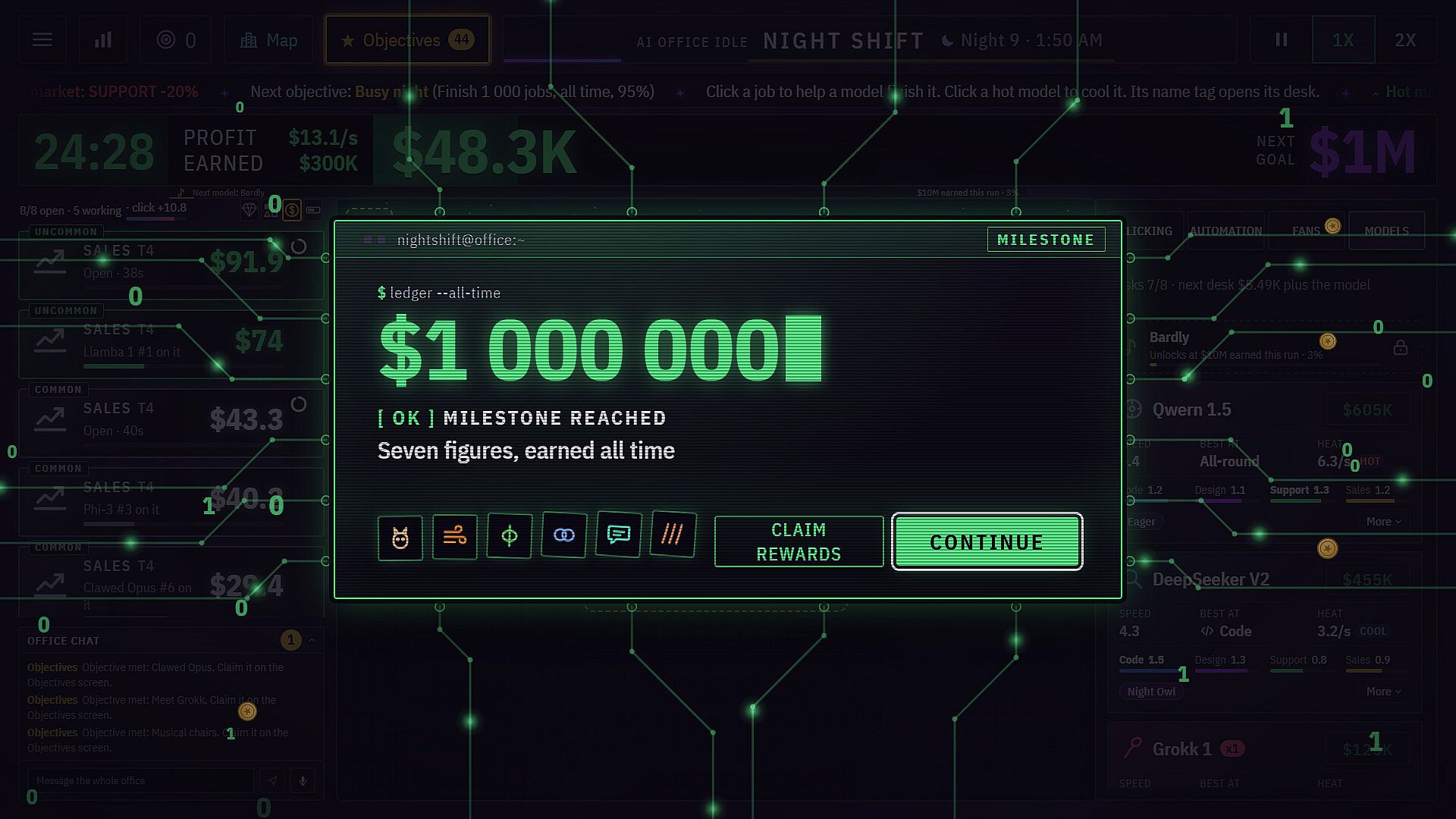
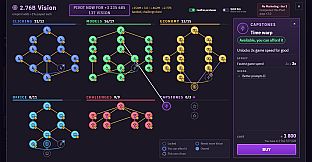
Standard runs focus on building revenue toward a one-million-dollar pivot that resets the current session but grants access to the Vision tree. This tree contains 67 permanent upgrades arranged on a single map with four either-or choice points and free respec options at each pivot. Eight distinct challenge runs alter core rules, such as restricting clicks or limiting the office to four desks, and multiply pivot rewards by up to three times.
Funding rounds introduce another layer by exchanging tree progress for equity stakes. The sixth round transitions the company to public status, after which gameplay continues. Nine chapters contain 220 objectives that guide players through unlocking 25 model families, each with unique overclock behaviors and voice responses. These elements combine idle automation with repeated strategic resets and targeted challenges.
Progression and Systems
Model families unlock progressively, bringing specialized rules for overclocking and distinct interaction styles. Jobs continue rolling in throughout the night, and players balance active cooling or messaging with passive systems like solar charging and battery storage. The Vision tree rewards repeated pivots with upgrades that persist across runs, encouraging experimentation with different challenge modifiers and office configurations. Five distinct office types on the city map support varied strategies for scaling operations.
Everything runs locally on the player's PC with no accounts, ads, or data collection required. The optional smart chatter feature activates a small local AI model only when enabled, keeping all processing offline.
Is It Worth Playing?
AI Office Idle: Night Shift suits players who enjoy idle management simulations with layers of strategy around resource balancing, model specialization, and long-term upgrade planning. The combination of heat mechanics, rarity-based jobs, communication choices, and pivot systems creates repeated depth without relying on constant active input. Offline earning and a substantial demo that carries saves forward lower the barrier to trying the full experience. Those seeking a focused single-player idle game with clear progression loops and multiple challenge variants will find consistent systems to explore over dozens of hours. The absence of online requirements or external dependencies keeps the focus squarely on the core simulation.