











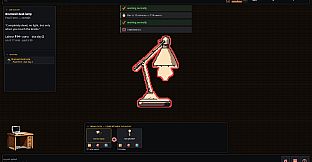
Repair Guru is a strategy simulation game for PC in which players run an electronics repair business. The experience centers on diagnosing and fixing genuine circuit faults in a range of household machines while also managing purchases, sales, staff, and workshop upgrades.
Gameplay
Each machine arrives on the bench as a complete, unsimplified circuit built from real components. A resistor may have drifted in value, a capacitor may leak, or a solder joint may fail only after the board warms up. The meter readings reflect exactly what the circuit would produce in reality, with no scripted solutions or step-by-step lists provided by the game.
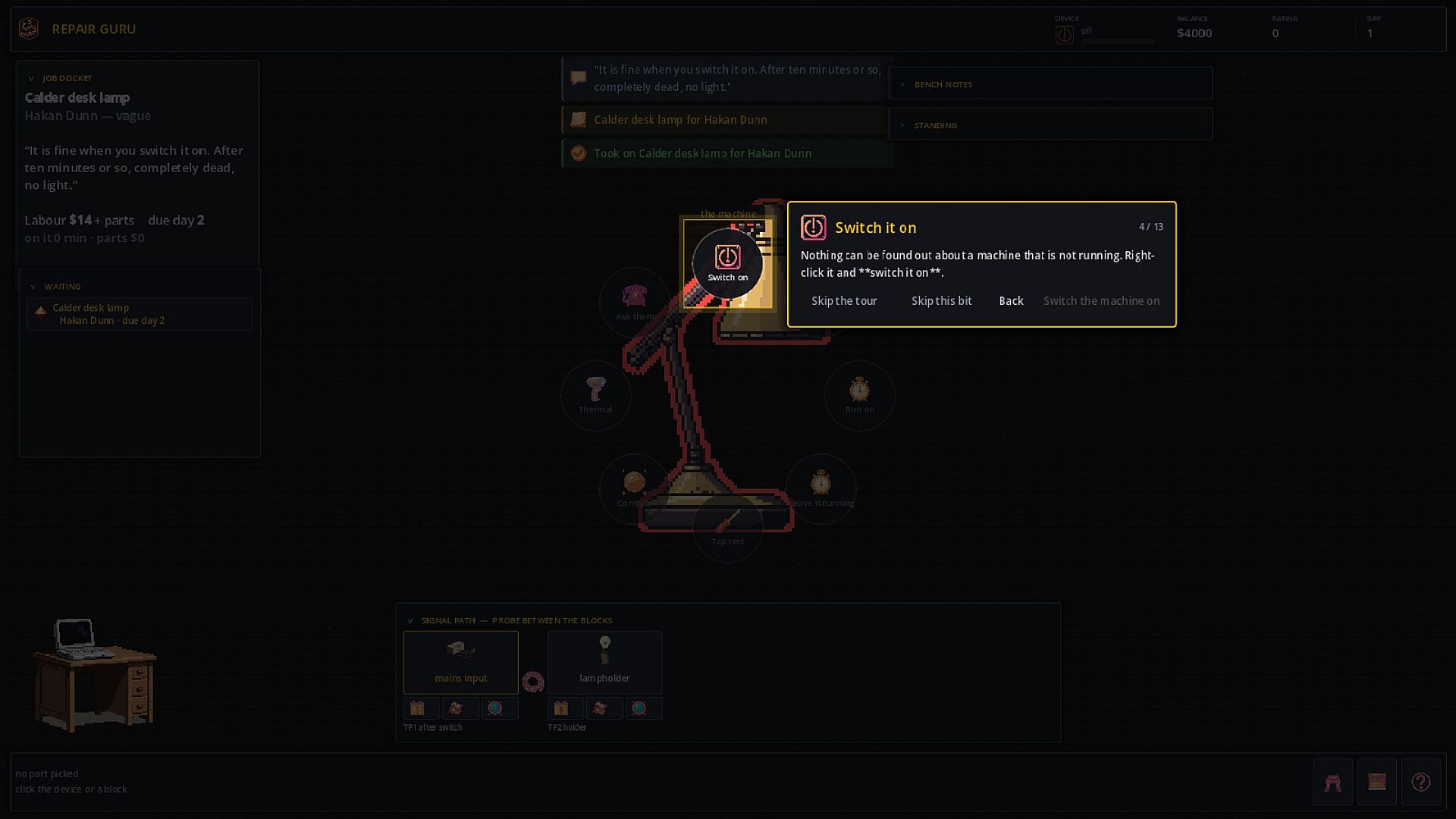
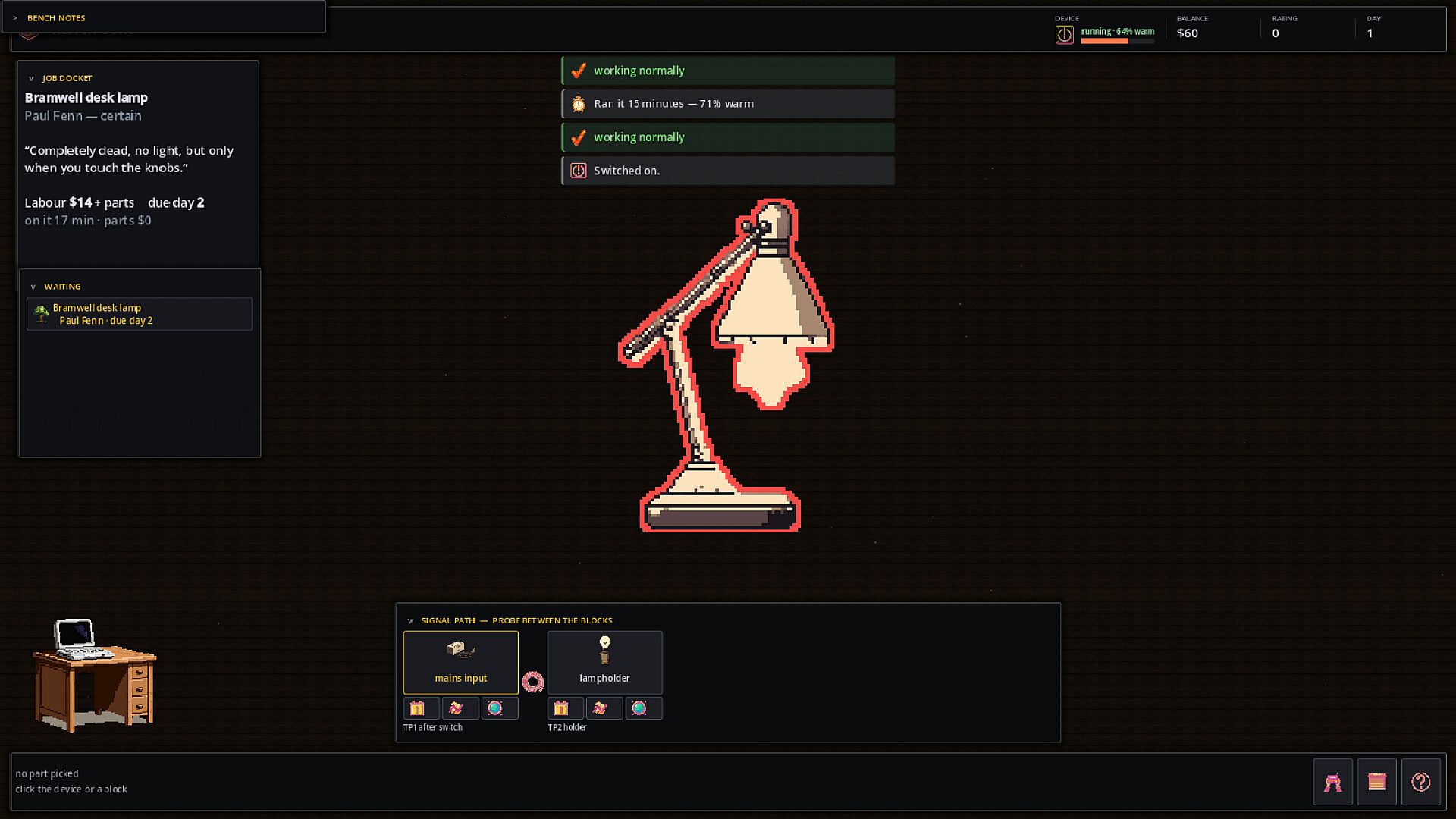
Diagnosis follows a systematic halving process. Every machine consists of blocks separated by test points. Measuring at the midpoint of a chain immediately eliminates half the remaining possibilities, and repeated probes narrow the search until the fault is isolated. The player must perform every measurement; the game never reveals the answer.
Many faults remain hidden until the machine is powered on and allowed to run. A dry joint may hold when cold yet open at operating temperature. A worn control may crackle only while the knob turns. A cracked track may require a physical knock to appear. Players watch behavior, listen for changes, and apply a thermal camera to locate heat signatures that indicate the problem area.
Sound is generated live from the same electrical readings used for visuals, so audio provides direct diagnostic evidence rather than background decoration. Machines may stutter, lose power, or even smoke when faults are present, giving immediate feedback on the state of the repair.
Game Modes
The core activity divides into two interconnected loops. On the bench, players locate and correct faults across twenty-six distinct machines that range from simple desk lamps to complex home organs. Twenty-seven component types appear throughout, producing five hundred and fifteen possible faults in total, each of which must be identified through measurement and observation before any part is replaced.
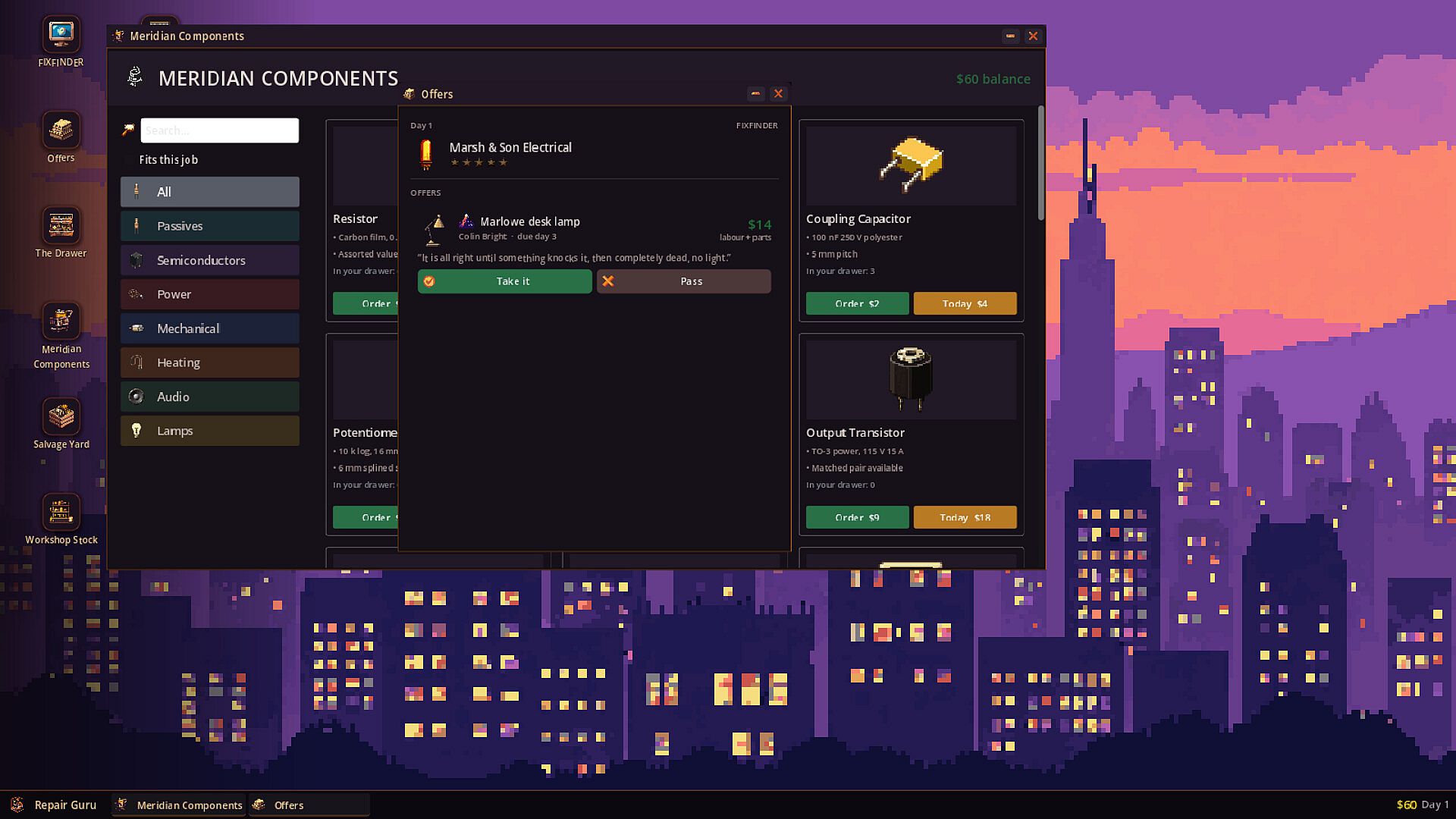
The second loop involves acquiring broken equipment from a salvage yard, restoring it on the bench, and reselling it through a shopfront. Listings are limited by license, and visibility depends on purchased advertising. Reputation rises with successful repairs and falls sharply when a machine returns faulty, encouraging thorough testing at multiple temperatures and under physical stress before any sale.
Workshop Management
Progress comes from reinvesting earnings into better tools rather than abstract upgrades. A higher-resolution oscilloscope improves measurement precision, a logging meter records multiple test points in a single pass, and a bench supply removes uncertainty about mains power. Staff can be hired, each requiring wages that must be earned through completed work each day.
Specialization develops naturally from the machines repaired most often, bringing repeat business in those categories. Inventory of spare parts begins limited and must be replenished carefully, since replacing entire boards component by component quickly exhausts resources and time.
The day is measured in hours, and every action consumes them. Wages are paid from the till each morning regardless of earnings, so efficient fault location and reliable repairs directly affect long-term viability.
Is It Worth Playing?
Repair Guru delivers a focused, hands-on simulation of real-world electronics troubleshooting and small-business operation. The absence of microtransactions, online requirements, or additional launchers keeps the experience self-contained. It runs on modest hardware and supports multiple languages.
Players who enjoy methodical problem solving, realistic cause-and-effect mechanics, and the satisfaction of turning broken equipment into working stock will find the systems rewarding. Those seeking fast action or guided tutorials may find the open-ended diagnosis process demanding. The combination of precise circuit work and shop economics creates a complete loop that rewards careful observation and disciplined testing.
- Twenty-six machines with 515 unique faults
- Intermittent and temperature-dependent failures
- Shopfront sales and reputation system
- Tool and staff progression