




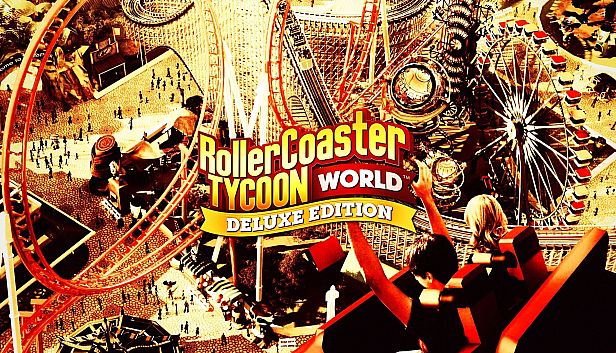














RollerCoaster Tycoon World is a theme park simulation game for PC that centers on designing, constructing, and operating amusement parks in fully three-dimensional environments. Players handle coaster layouts, guest flow, financial tracking, and service management while shaping terrain and placing attractions across varied maps.
Gameplay
The core loop revolves around creative construction paired with ongoing park oversight. Builders use a spline-based editor to shape roller coaster tracks freely in three dimensions, allowing complex loops, drops, and twists that respond to detailed physics calculations. Flat rides, shops, and scenery items slot into place with freeform positioning at any angle, while paths can curve to match custom layouts. Terrain deforms on the fly, and water features integrate directly into the landscape.
Management tools track guest opinions, park finances, and operational needs through heat maps and service systems for medical, janitorial, mechanical, and entertainment tasks. Themed zones influence guest preferences, and players can ride completed coasters from the front seat to test designs. Piece-by-piece building supports custom structures across multiple themes, and deformable environments encourage experimentation with elevation and water elements.
Game Modes
Progression Mode delivers a mission-based campaign spread across three world maps. Dozens of objectives increase in complexity, rewarding research points that unlock additional scenery for later use. Multiple objectives per mission support different approaches to park development.
Sandbox Mode removes resource limits and grants access to unlocked content, letting players focus entirely on unrestricted building. An unlimited variant provides the complete roster of rides and items immediately for open-ended creation without progression gates.
Building and Customization
Advanced tools emphasize flexibility. Curved paths, freeform object placement, and a piece-by-piece system with over 260 premade tiles across four themes enable detailed custom environments. Steam Workshop integration supports user-generated content, including imported models and shared blueprints for coasters or entire parks. Multiple map environments and themes further differentiate each creation.
Guest behavior reacts to surroundings, with themed objects boosting ride appeal in matching zones. Advanced coaster physics add realism, where designs can succeed spectacularly or fail dramatically if tracks prove unstable.
Is It Worth Playing?
The game suits players who prioritize detailed coaster construction and open park building over polished management depth. Its 2016 release established the 3D systems and mission structure that remain the primary draw. Player feedback highlights the creative tools as strengths while noting stability and interface concerns that persist in the current version. Those seeking a focused building experience without ongoing seasonal content may find value in the sandbox options, whereas players expecting frequent updates or refined simulation layers may prefer alternatives in the genre.


