




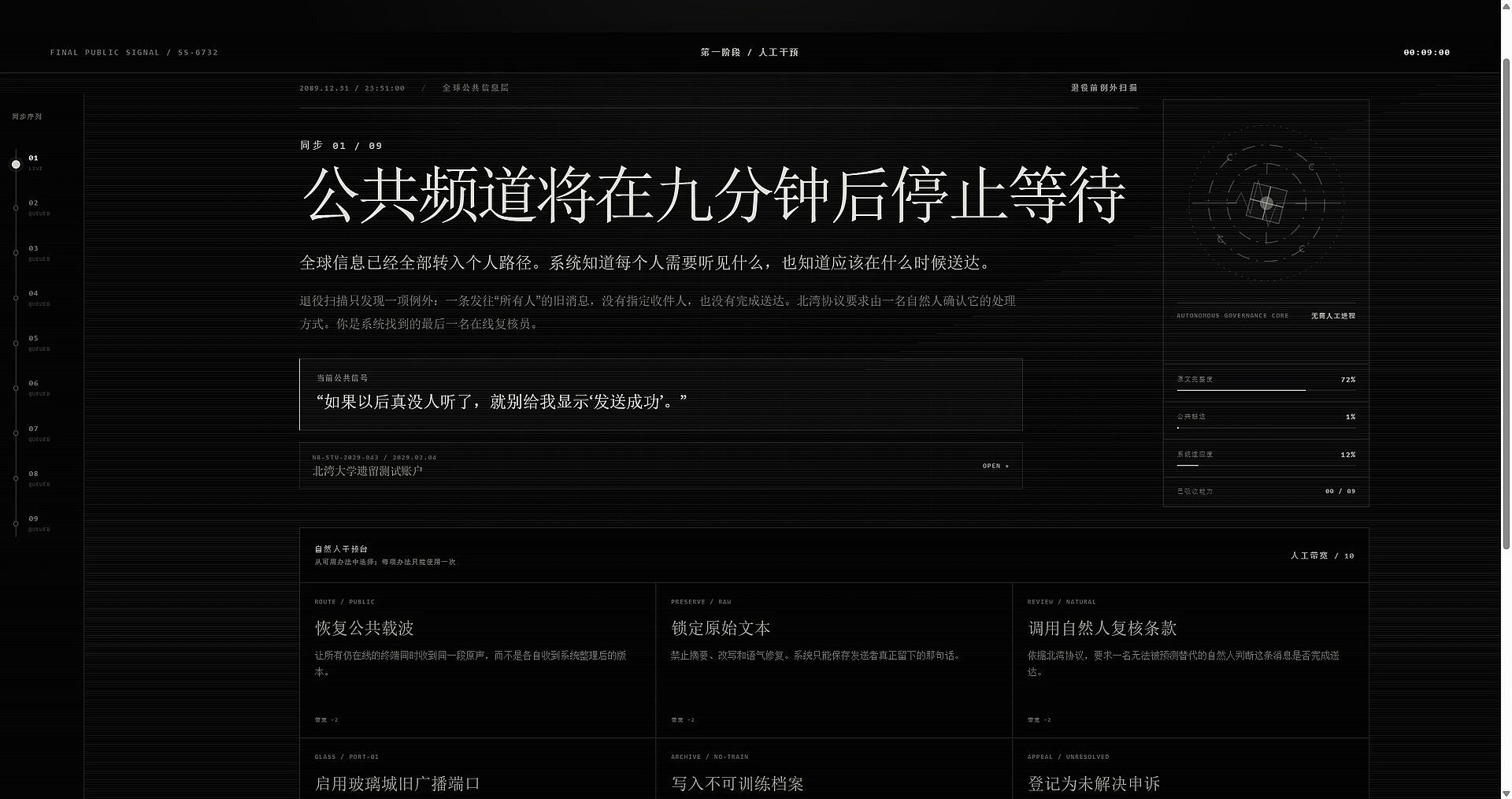







North Bay Protocol is a single-player narrative strategy and simulation game focused on AI governance and institutional decision making. Set in a city where public choices increasingly fall to automated systems, players navigate crises through reports, resource allocation, and policy responses that carry lasting effects across multiple time scales.
Gameplay
The core loop centers on processing event reports that detail unfolding emergencies and competing interests. Players select responses that impose immediate costs in resources and institutional capacity while managing secondary factors like trust and adaptation levels. Decisions trigger delayed outcomes that appear weeks later as debt settlements, chained events, or shifts in public records. This structure emphasizes trade-offs rather than optimal solutions, with each choice altering the conditions for subsequent crises.
Mechanics revolve around reading narrative text to assess stakes, then committing limited assets to one of several options. Conditions such as capacity, trust, and adaptation must stay within viable ranges to avoid systemic collapse. Branching consequences emerge from prior selections, creating interconnected sequences that reward careful tracking of long-term impacts over short-term fixes.
Game Modes
The experience unfolds across three distinct chapters that vary in interface, pacing, and decision focus. Chapter One emphasizes crisis response under resource constraints and accumulating debt. Chapter Two shifts attention to how institutional choices affect individual lives and behavioral patterns. Chapter Three examines the final record of events, where preservation, reinterpretation, or erasure shapes the official narrative of outcomes.
Randomized event combinations introduce replay variation within this chapter framework. Multiple endings and hidden results appear depending on the path taken, and scoring does not always align with narrative quality. A full playthrough typically lasts around three hours, influenced by reading pace and the depth of choices explored.
Narrative Structure and Consequences
Text-driven presentation forms the foundation, with atmospheric music and visual styling that differentiate each chapter. The game avoids traditional action or construction elements, instead building tension through systemic ripple effects. Players confront situations where not all objectives can be met, forcing prioritization of acceptable risks and identification of who ultimately bears the costs.
Event chains and debt mechanics ensure earlier compromises resurface in later stages. This creates a sense of institutional memory that persists beyond individual sessions, highlighting how temporary measures evolve into permanent protocols.
Is It Worth Playing?
North Bay Protocol suits players drawn to deliberate, text-heavy strategy experiences centered on governance and long-term repercussions. Its single-player format and chapter-based progression deliver a contained narrative arc without requiring ongoing time investment. The emphasis on unavoidable trade-offs and non-linear outcomes provides replay value for those who enjoy analyzing decision trees and alternative histories.
As an upcoming title with no released player data yet, its appeal rests on the described mechanics of resource management, consequence tracking, and institutional simulation. Those seeking fast-paced action or competitive elements will find little here, while fans of interactive fiction and policy-focused simulations may appreciate the focused scope and thematic depth.