


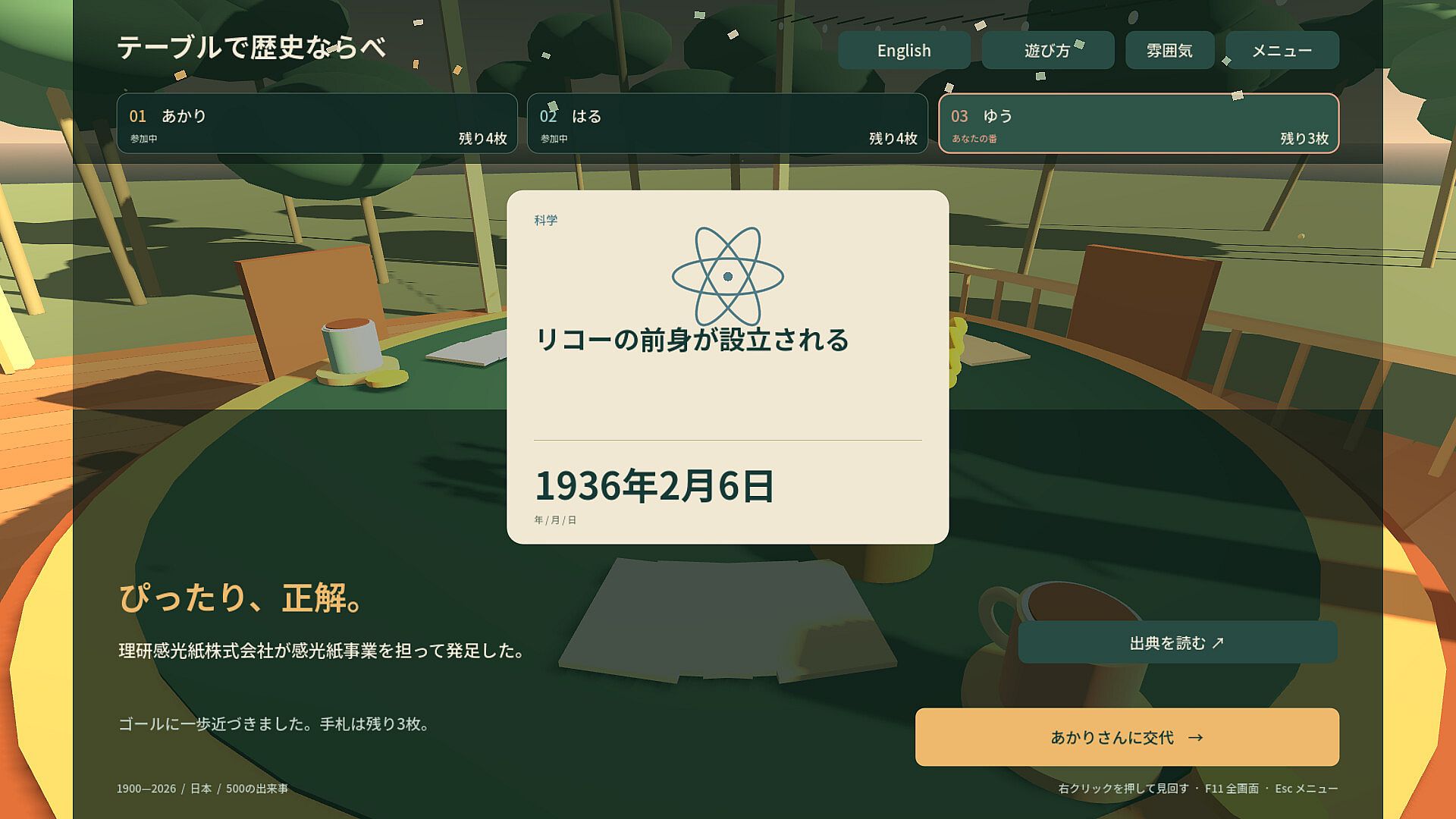
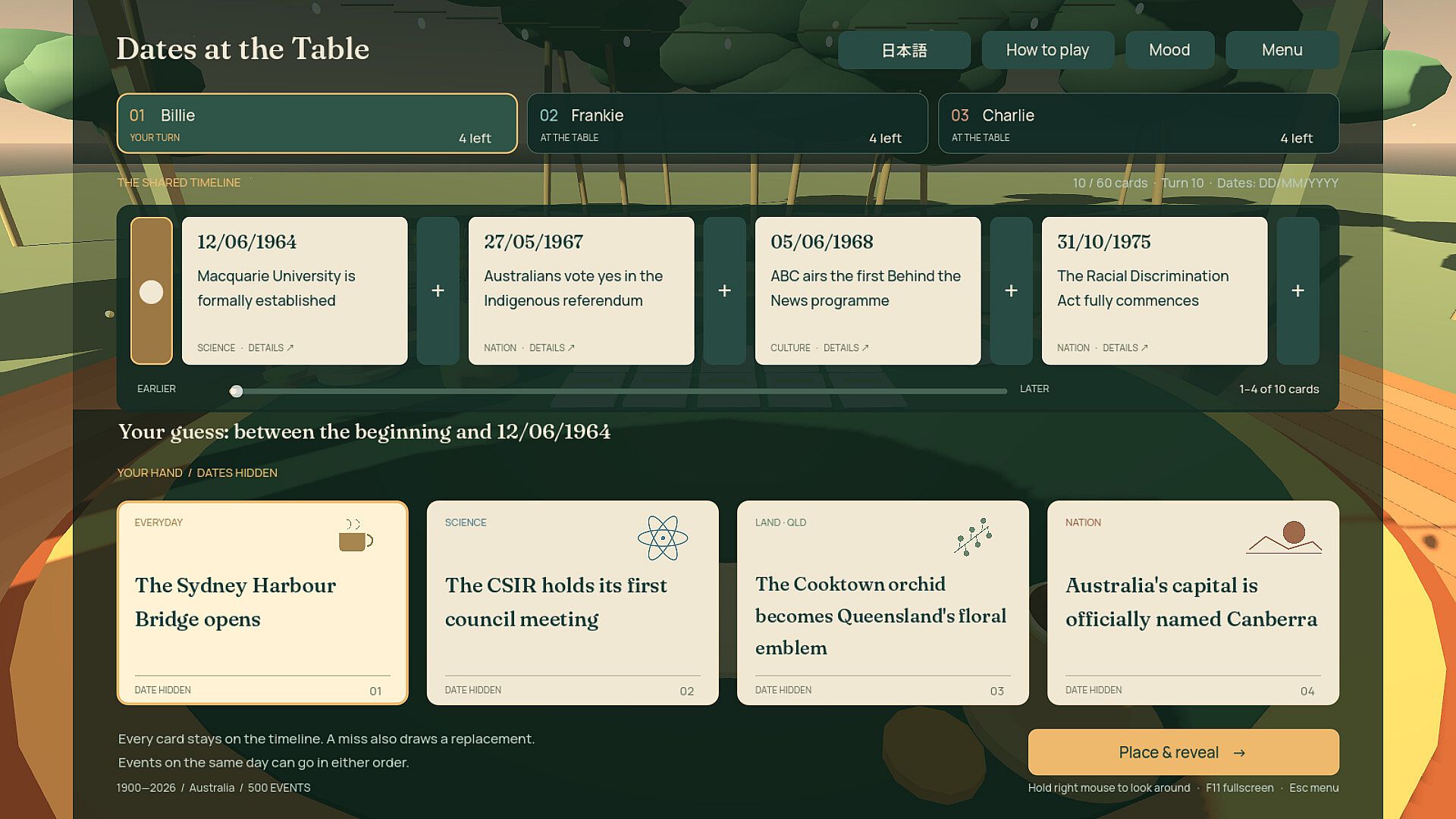
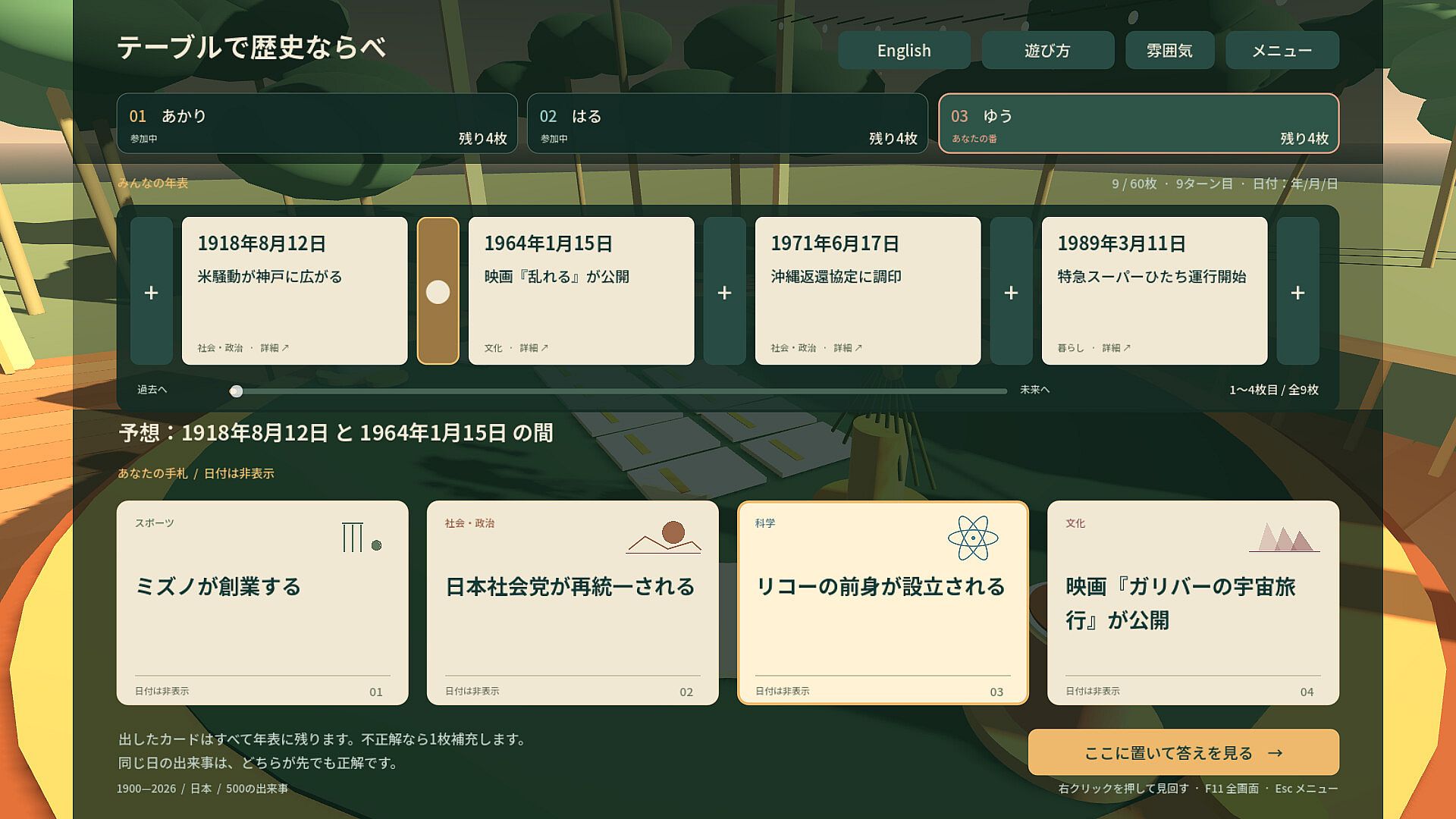
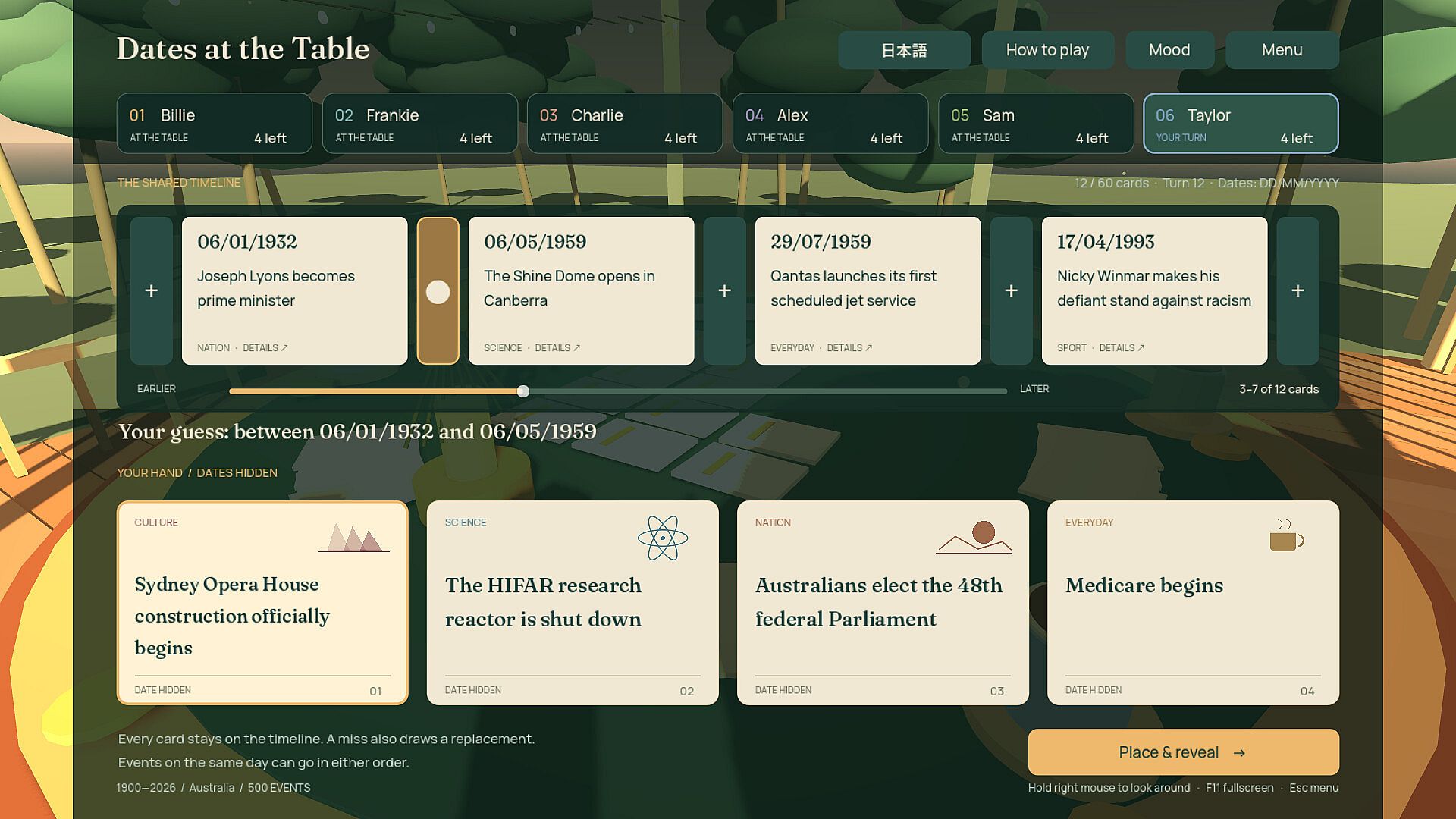

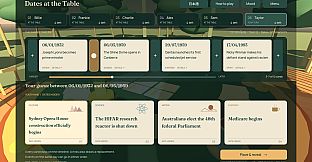
Dates at the Table is a first-person timeline card game that challenges players to arrange historical events in the correct chronological order. Developed as an indie casual title for PC, it centers on two distinct decks of 500 events each drawn from Australian and Japanese history between 1900 and 2026. Players receive four cards at a time with dates concealed and must position them on a shared timeline before revealing the exact dates to check accuracy.
Gameplay
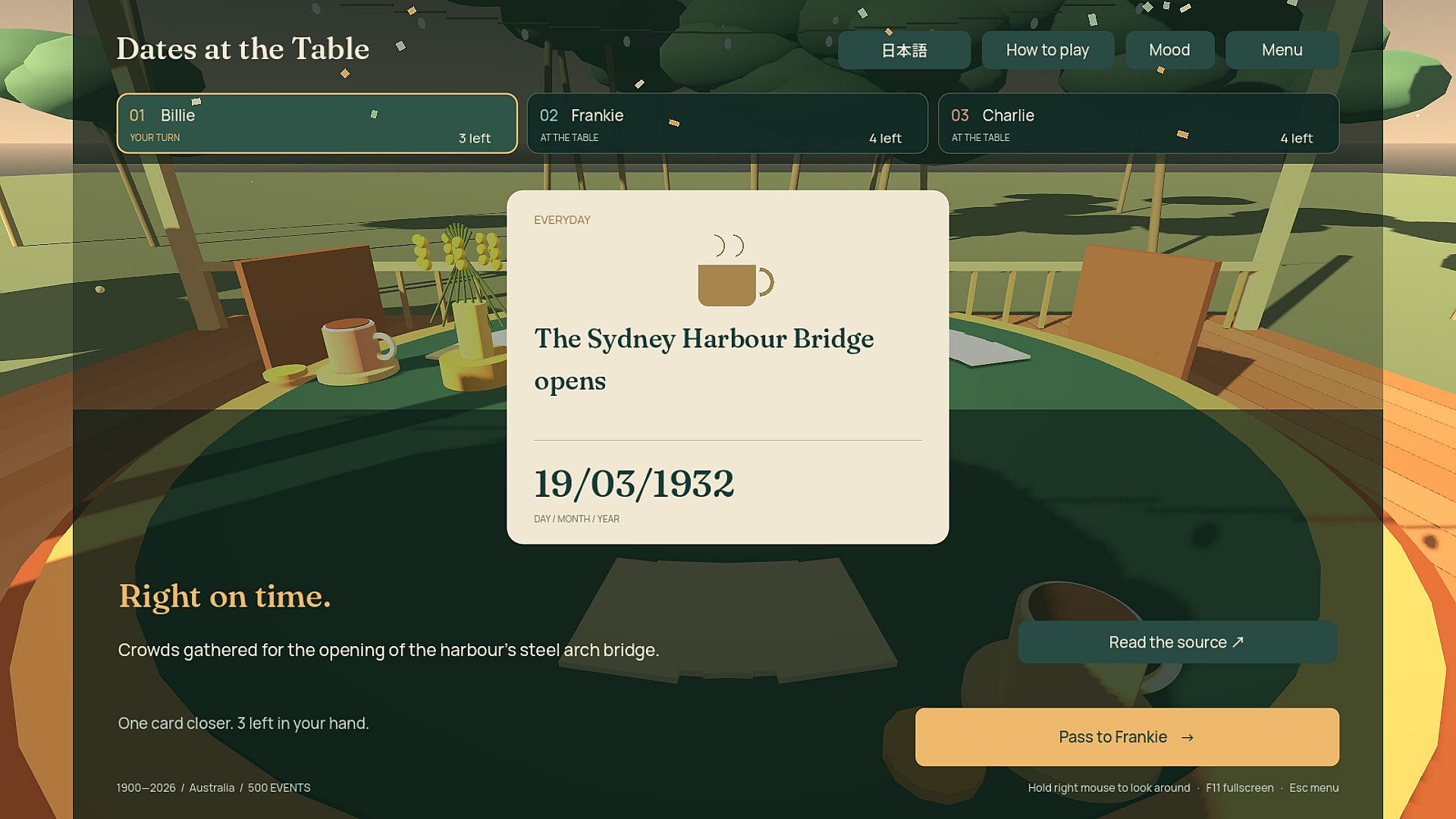
The core loop revolves around building and refining a growing timeline through careful placement and deduction. Each turn a player selects one card from their hand and inserts it into the sequence where they believe it belongs. After placement the date is revealed, and correct positioning reduces the hand size while an incorrect guess requires drawing a replacement card. The misplaced card remains on the board in its verified spot, supplying additional context for future turns.
A timeline slider lets participants scroll through the expanding sequence at any point. Once the board reaches 60 cards, play continues on a fresh timeline while hands and overall progress carry over. Events that share the same day may occupy either order without penalty. Every revealed card displays a concise fact, the precise date formatted according to the chosen country, and a source reference that opens externally when selected.
Atmospheric options include adjustable lighting between sunset and blue-hour tones, subtle ambient sounds, and optional confetti effects upon successful plays. Reduced-motion settings and automatic local saves support comfortable extended sessions without altering core rules.
Game Modes
Solo play follows the same placement and reveal mechanics until the player empties their hand. Local pass-and-play supports up to six participants sharing a single computer, with a handoff screen managing turns. Online sessions accommodate two to six players through Steam, where each participant views a private hand while the timeline and revealed cards remain visible to all. Matches require matching game versions and an active internet connection; sessions end if a player disconnects and do not support mid-game rejoining or saves.
Language selection operates independently of deck choice, allowing English or Japanese text for either Australian or Japanese events. Both decks feature fully translated titles, facts, rules, and interface elements.
Decks and Content
The Australian deck emphasizes events across politics, culture, science, sport, daily life, and nature, with particular depth on Queensland occurrences. The Japanese deck covers the same broad categories using year-month-day formatting, including traditional Japanese date notation when the interface is set to Japanese. Source references accompany every card for further exploration, though the game itself contains no playable violence or graphic imagery.
Two separate 500-card collections keep content distinct, encouraging repeated playthroughs to compare regional timelines or switch languages for a different perspective on the same events.
Is It Worth Playing?
Dates at the Table suits players who enjoy deduction-based card games and factual history challenges. Its straightforward placement mechanics and clue-building system reward attention to emerging patterns rather than prior knowledge alone. Local multiplayer works well for small groups around one device, while online options extend the experience to remote participants without requiring complex setup.
The title remains in a pre-release state with no user reviews available yet. Those drawn to casual, educational card play or bilingual historical content will find the independent decks and flexible language support particularly appealing. Solo sessions provide a steady pace for personal improvement, and the absence of mid-match saves in online modes encourages focused short games. Overall it delivers a clean, focused experience for history enthusiasts and casual gamers seeking a fresh twist on timeline ordering.