




Make the process of AI learning visible
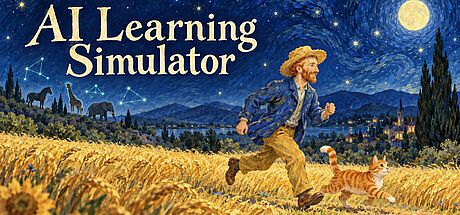
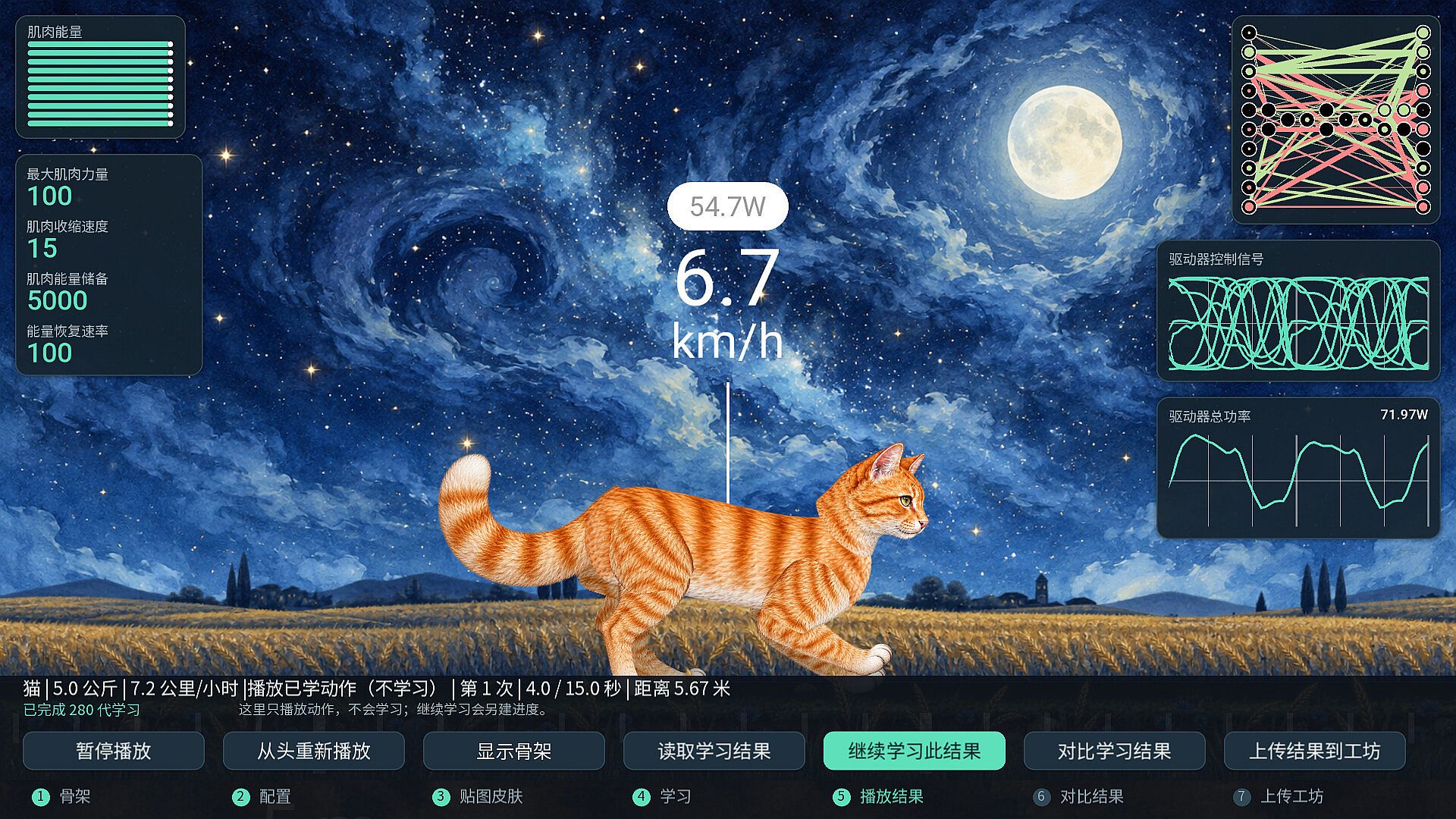
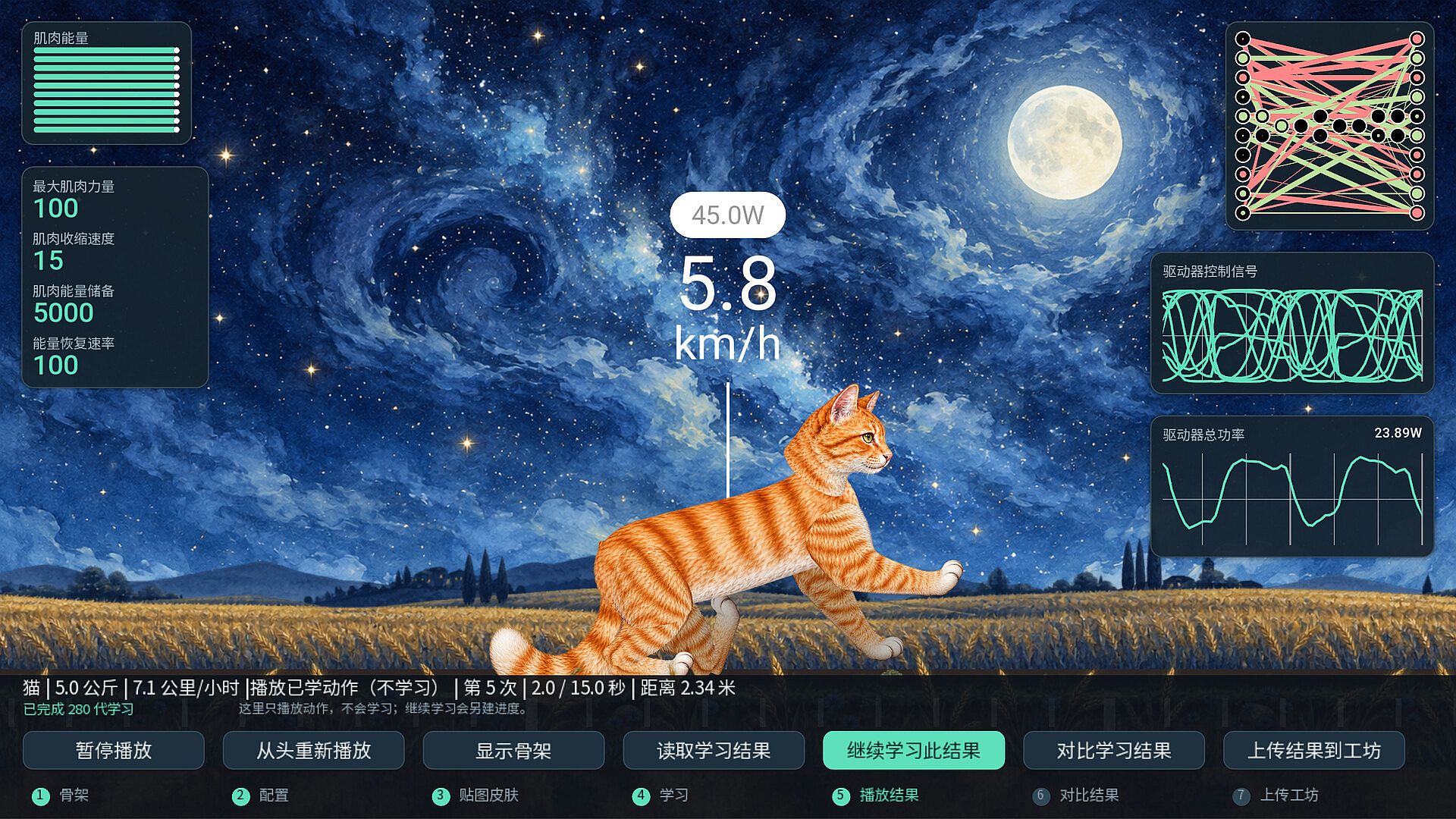
A cat has a body, joints and actuators. Now it needs to find a way to move forward.
Its first attempts may be clumsy: limbs interfere with one another, balance is lost, and great effort produces almost no movement. After many generations of trials, some actions begin to produce useful displacement. Some control strategies are retained, and new ways of moving may emerge.
AI Learning Simulator is a free physics-based training and observation game. Design bodies, adjust parameters, run training, and observe how neural networks search for effective behavior within the constraints of a body and its environment.
Every improvement can become a concrete experiment in artificial intelligence.
Design a body, then observe how it learns
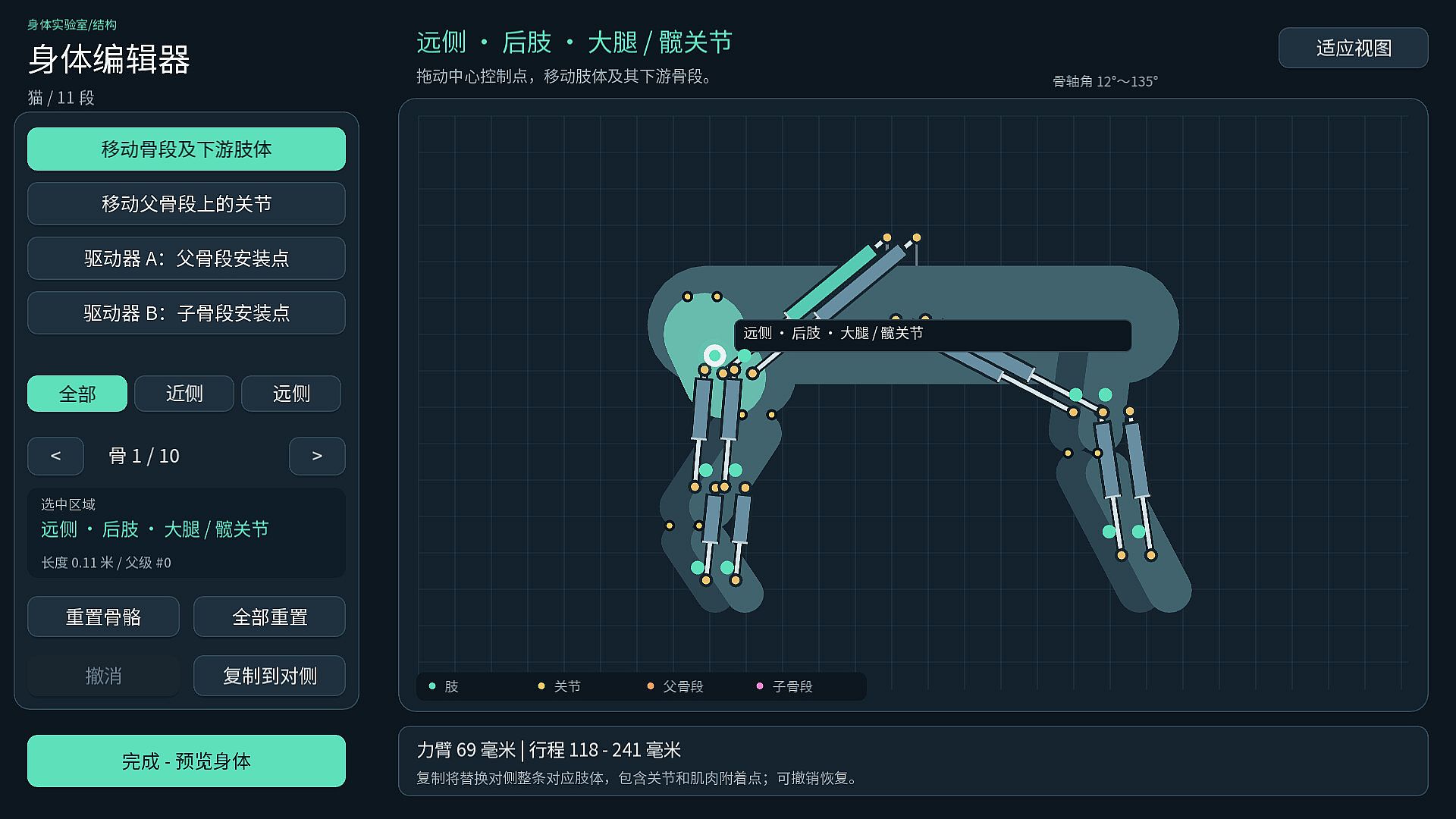
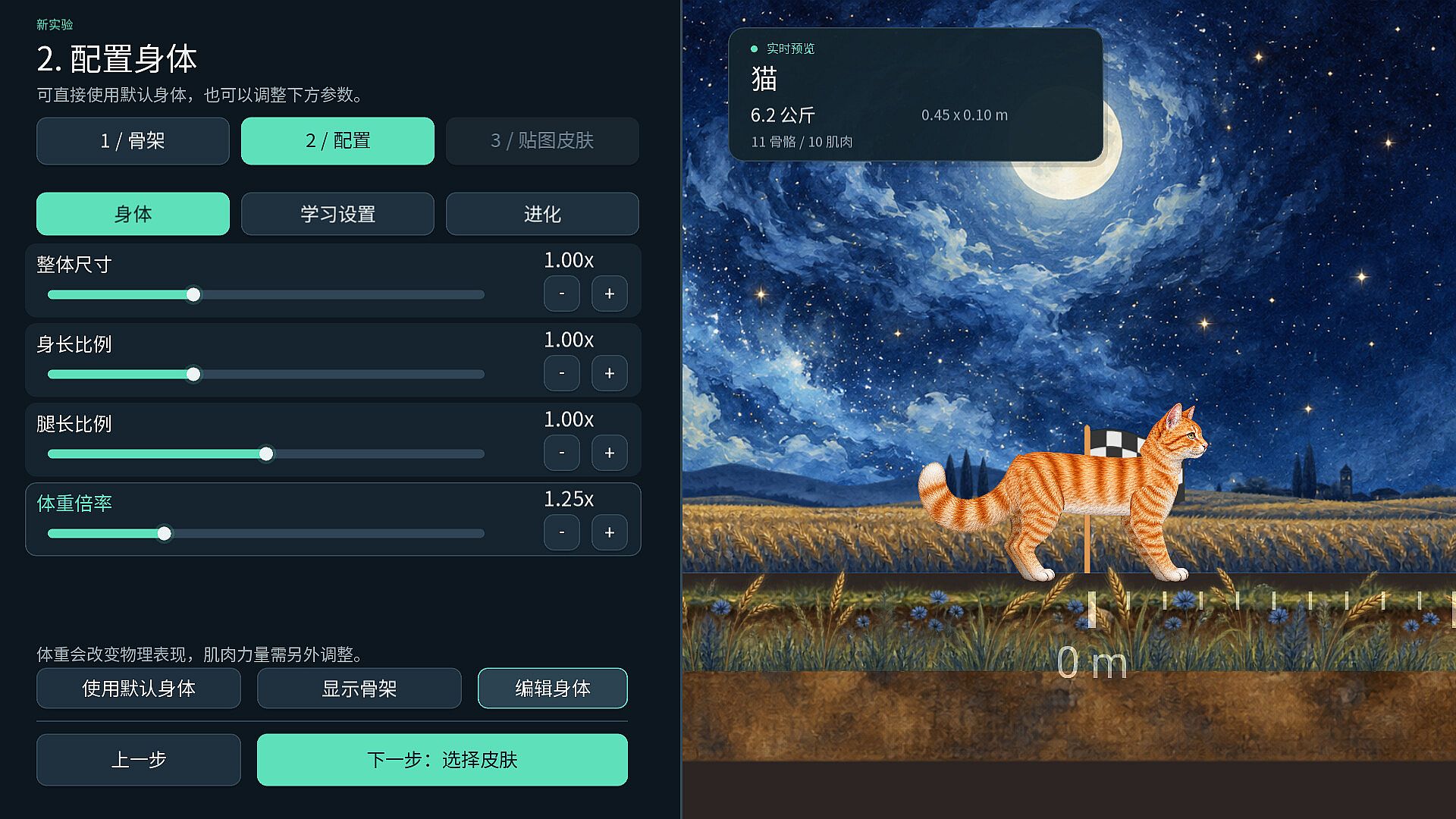
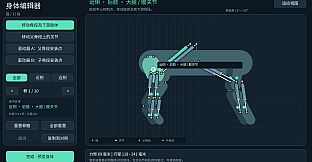
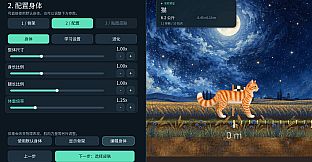
Start with a cat, elephant, giraffe, horse or biped. Adjust size, limb proportions and weight, or edit bone segments, joints and actuator mounting points in greater detail.
These parameters directly change the learning problem.
Longer legs change both the range of motion and the conditions for balance. A heavier body increases the load. Moving an actuator's mounting points changes its moment arm around a joint. The same controller can produce very different results in different bodies.
Movement emerges from the combined effects of body structure, actuator capabilities and control strategy.
The skeleton defines how the body can move, actuators supply force, and the neural network organizes control signals from its inputs. Textures give the character its appearance; movement must prove itself in the physical simulation.
How a neural network turns states into actions
In the game's current control model, the network receives the relative extension of each linear actuator. These values are its way of observing the body.
Values pass through connections with different weights. Neurons also have biases and activation functions. For one neuron, the calculation can be understood as:
Output = activation function (Σ(input × connection weight) + bias)
Weights determine the influence of each input. Bias shifts a neuron's response. Activation functions allow the network to form more complex, nonlinear relationships.
Nodes and connections work together to produce control outputs for the actuators. Changing network parameters changes how the body responds to the same state.
Every lifted leg, moment of support or loss of balance corresponds to a sequence of numerical calculations and physical feedback.
Movement takes shape through continuous feedback
Control does not end after a single calculation.
Actuator states enter the network. It produces control signals. Actuators move joints. Gravity and ground contact affect the body. The resulting state becomes the input for the next calculation.
This cycle continues:
Body state → neural network → actuator control → physical movement → new body state
An output's effect also depends on the body's current posture, motion and contact conditions. The same actuation can have different consequences when a leg is swinging through the air and when it touches the ground.
Gait rhythm and coordination may gradually emerge through feedback between controller, body and environment. Observing movement also means observing this closed loop at work.
How training changes behavior
The game primarily searches for control strategies through neuroevolution.
Training evaluates a population of candidate networks. With different control parameters, each attempts movement in its own physical simulation. After each generation, the system compares performance, lets better strategies influence the next generation, and introduces new attempts through mutation.
The process repeats:
- 1. Generate a population of candidate control networks.
- 2. Run physical trials for a fixed duration.
- 3. Score movement performance.
- 4. Retain some better strategies and produce modified networks.
- 5. Test again and continue comparing.
Changes can affect connection weights and neuron biases, or add nodes and connections. The network's structure itself can be part of the search.
An important distinction: during a trial, the controller repeatedly calculates with its current parameters. Between generations, training searches for new parameters through selection and mutation.
A moving character shows the current strategy being executed. Differences between generations show the results of training.
What it learns depends on how we evaluate it
The current core task is to move as far forward as possible within a fixed time. Performance is evaluated mainly by the furthest horizontal position the character has reached.
This simple objective can produce many interesting observations.
Going further does not necessarily mean moving more naturally. Performing well in a short trial does not guarantee stability over a longer one. Force and energy constrain actions, but distance, elegance of movement and energy efficiency remain different objectives.
Training pushes the metric we define toward improvement. Whether that metric fully represents our expectations is a question for the person designing the experiment.
When an unexpected movement emerges, look back: what inputs did we provide, what actions did we permit, and what rules did we use to define success?
Understanding these questions is part of understanding artificial intelligence.
Learning can stall and is limited by its conditions
Progress during training is rarely uniform.
Sometimes a whole batch of attempts appears ineffective. Sometimes a small change brings a clear improvement. At other times, performance may remain similar for many generations.
Population size affects the number of attempts, mutation affects the extent of exploration, and body structure defines possible movement. More generations provide more search opportunities, but cannot guarantee that every body learns to walk stably.
More neurons do not automatically mean a better strategy, either.
Interpret each result alongside its body, actuator capabilities, evaluation duration and scoring rules. The generation count records how many rounds of evaluation have taken place; actual ability must still be judged through performance.
Change the conditions, train again, and compare results from different experiments.
Save your experiments
The game offers a complete path from design to sharing:
- Choose a body template: start with a cat, elephant, giraffe, horse or biped.
- Adjust body and actuator structure: change size, proportions and weight; edit joints and actuator attachment points.
- Configure training: adjust population size, evaluation duration and evolution parameters, and observe their effects.
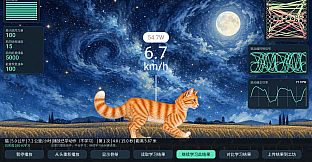
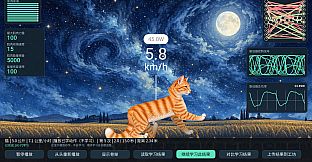
- Inspect performance: observe network structure, actuator signals, movement scores and training generations.
- Save and continue training: keep the body configuration and best strategy, identify results by animal thumbnails and cumulative generation counts, then explore further from a saved strategy.
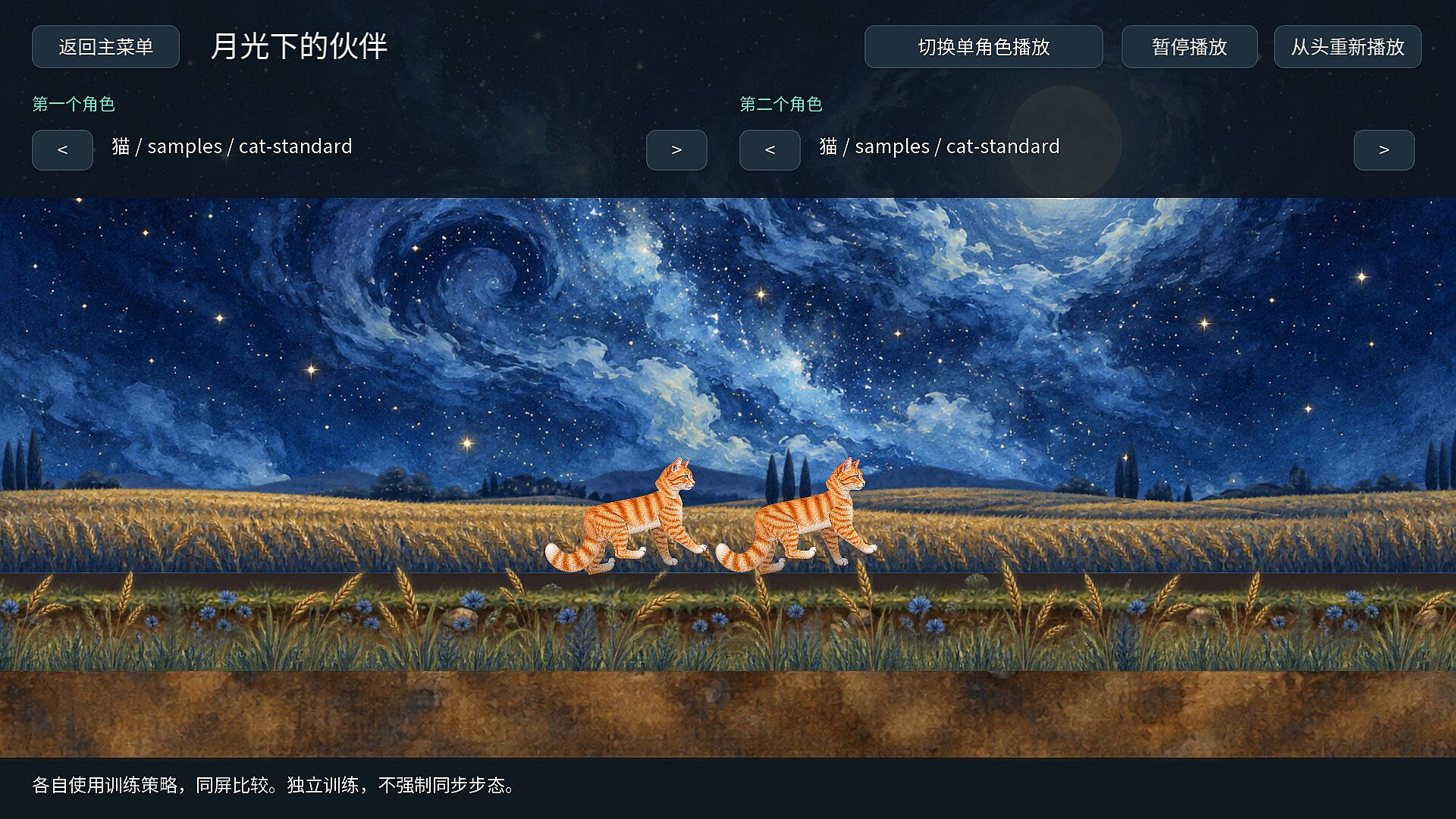
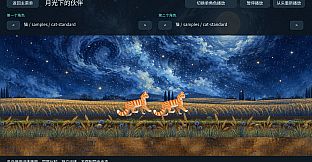
- Observe and compare on one screen: replay two characters' learned strategies independently to compare different bodies or controllers.
- Change appearances and share: use animal, human and picture-book skin templates. Download or upload skins and trained results through Steam Workshop.
The game includes a cat strategy trained for a total of 280 generations. Replay it directly or use it as a starting point for further training and observe what changes.
A cat's attempts reveal one small part of AI learning
In picture-book scenes of moonlight, starry skies and wheat fields, take your time observing a control strategy, or redesign the body and begin your own experiment.
A seemingly simple forward movement connects input encoding, neural computation, body dynamics, evaluation rules and probabilistic search.
We hope this free game turns abstract concepts into processes you can observe, adjust and test repeatedly. Build your own judgment: what information does a system receive, what actions can it take, and under which conditions does effective behavior appear?
Developed by Magiccat and available free of charge. Training runs locally on your computer. Steam Workshop features require signing in to Steam.


