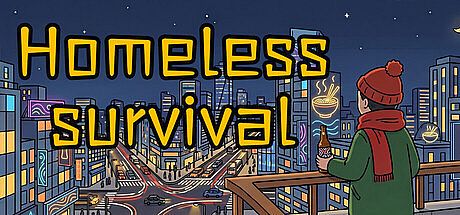






















Homeless Survival is an indie casual simulation game for PC that places players in the role of a drifter navigating life on the streets. The core loop revolves around managing basic needs while pursuing odd jobs, scavenging, and skill development to achieve citizenship and a fresh start. Every decision shapes a personal narrative of gradual improvement amid daily hardships.
Gameplay
The experience centers on a life system that tracks hunger, filth, and morale. These factors can trigger chain reactions of ailments that weaken the character over time. Interactions with passersby vary widely, from offers of help to outright hostility. Scavenging from dumpsters provides unpredictable results, including food scraps, materials, coins, or nothing at all. Collected scrap can be exchanged for money at recycling centers, though prices fluctuate and require careful negotiation.
Employment options span novice to advanced levels, supplemented by gambling activities such as blackjack that carry high risk and reward. Riskier street activities exist but carry consequences for those who overextend. The day-night cycle adds structure, with nights spent in varied locations like open streets, shelters, or paid accommodations, each bringing distinct events. Nighttime activities consume energy and include options like theft, exploration, street performance, reading, or alchemy practice alongside other pursuits.
Progression relies on four core stats: Physique, Intelligence, Spirit, and Mental. These influence available skills and overall effectiveness. Talent perks offer flexible combinations that support diverse approaches. Players select starting identities that alter initial conditions, and challenge modifiers introduce restrictions that grant bonus talent points upon completion. The focus remains on building from zero through consistent effort and adaptive choices.
Game Modes
Homeless Survival operates as a single-player simulation without separate multiplayer components. The structure emphasizes personal progression through its integrated systems rather than distinct named modes. Different starting identities and challenge modifiers allow varied playthroughs, each emphasizing unique stat builds and risk profiles. The night system further branches experiences based on location choices and energy allocation, creating replayability within the core single-player framework.
Core Mechanics and Progression
Survival demands constant attention to physical and mental states while balancing income sources. Jobs provide steady advancement, yet gambling and scavenging introduce volatility that can accelerate or derail progress. Alchemy and skill practice tie into the stat system, enabling unconventional strategies when combined with perks. The supernatural elements mentioned in the premise appear as optional high-stakes paths that players may pursue or avoid depending on their risk tolerance.
Character growth feels incremental. Early focus on immediate needs gives way to longer-term planning as stats improve and options expand. Challenge modifiers encourage experimentation by altering rules for additional rewards, supporting multiple attempts at transformation from street life to stability.
Is It Worth Playing?
This title suits players who enjoy deliberate simulation experiences centered on resource management and incremental improvement. The systems for needs, jobs, and nighttime decisions create a grounded loop that rewards planning without overwhelming complexity. As an upcoming release planned for 2026, it currently offers no player reviews or post-launch updates for assessment. Those drawn to indie simulations with stat-driven progression and choice-based storytelling may find the premise compelling once available. The game targets single-player audiences seeking a focused narrative of redemption through persistent effort rather than fast-paced action or competitive elements.